
Sunday, March 27, 2005
EC posts
For those sick of the EC thing, I'll slow down on those postings now and move on to other things. I just wanted to get one story each from the 14 major EC artists out of the way. Of course that still leaves some interesting artists who only did a handful of stories for EC (among them Joe Kubert, Russ Heath, Alex Toth, Ric Estrada and Gene Colan, plus the "Fleagle Gang" types who assisted Williamson on a few stories and did some solo. Speaking of which, does anyone know if Angelo Torres' "An Eye For An Eye" was ever printed outside of the early 1971 HORROR COMICS OF THE 1950s book and the ISF hardcover volume of the EC Library?). I'll probably get back to the one-story-per-week, 20-year plan now.
Saturday, March 26, 2005
EC - Stampede (Severin)
Stampede
art by John Severin, story by Colin Dawkins
Two-Fisted Tales #38[#21] (1954)
 John Severin of course a mainstay of the adventure books at EC, with art in almost every issue of FRONTLINE and TWO-FISTED (sometimes doing the full issue of TWO-FISTED when he took over the editing of the book), often inked by Will Elder on the earlier work, later inking himself. He also did a fair bit of work in MAD. Both the adventure and humour work would serve well in his later career (still on-going, unless Williamson is still working somewhere I don't know about I think Severin is the only major EC artist still active in comics), where he did a lot of war and western comics for various publishers and was the main artist for CRACKED for a long time (possibly still, I'm not clear what the status of CRACKED is).
This issue of TWO-FISTED is one of those where Severin drew the whole issue, after they moved the emphasis of the book from war to general adventure. This particular story is a western, of course, opening up with a dynamic scene where Slim rescues Avery from a stampeding herd. Slim then joins the ranch, but refuses to get involved in a barroom brawl and is branded a coward. Following an incident of cattle rustling, we get a shoot-out and Slim reveals his true identity and reason for not getting involved in the fight.
Of course Severin knows western art as well as anyone in comics, so this story's wide range of standard western settings and situations give him a chance to do a lot of great detailed art in just seven pages. It's full of the intricate pen-work that Severin is known for.
John Severin is the focus of the upcoming EC fanzine SQUA TRONT #11, reviewed here.
art by John Severin, story by Colin Dawkins
Two-Fisted Tales #38[#21] (1954)

This issue of TWO-FISTED is one of those where Severin drew the whole issue, after they moved the emphasis of the book from war to general adventure. This particular story is a western, of course, opening up with a dynamic scene where Slim rescues Avery from a stampeding herd. Slim then joins the ranch, but refuses to get involved in a barroom brawl and is branded a coward. Following an incident of cattle rustling, we get a shoot-out and Slim reveals his true identity and reason for not getting involved in the fight.
Of course Severin knows western art as well as anyone in comics, so this story's wide range of standard western settings and situations give him a chance to do a lot of great detailed art in just seven pages. It's full of the intricate pen-work that Severin is known for.
John Severin is the focus of the upcoming EC fanzine SQUA TRONT #11, reviewed here.
EC - Li'l Melvin (Elder)
Li'l Melvin
art by Will Elder (one panel by Basil Wolverton), story by Al Feldstein
Panic #3 (1954)
 Elder of course has two roles in EC history. He inked a lot of John Severin's work for the war and sci-fi books, complementing the pencils nicely (he also did a few solo stories in a few books, but those I've seen aren't too special). More important was his work on the humour books, as one of the key artists on the early MAD style with Kurtzman, where his ability to mimic other art styles and obsessively detailed art and in-jokes were invaluable. He brought the same skills to every issue of PANIC. He left MAD with Kurtzman and they continued to work together on various projects for decades.
This story is, of course, primarily a parody of Al Capp's Li'l Abner comic strip. As usual for Elder, it doesn't end there, and there are lots of other parodies, most notably the running joke with Walt Kelly's Pogo characters, plus sight gags and small jokes throughout. This particular story descends to self-parody by the end, with a page showing and "analyzing" the hidden messages in some of the panels (such as the small images of some Victrolas, a sample of phonographic pictures!). The story is pretty good up until then, even if you're not familiar with what's being parodied, but that final page is just magnificent.
As mentioned above, Basil Wolverton contributes one of his "ugly woman" drawings for a gag in this story.
art by Will Elder (one panel by Basil Wolverton), story by Al Feldstein
Panic #3 (1954)

This story is, of course, primarily a parody of Al Capp's Li'l Abner comic strip. As usual for Elder, it doesn't end there, and there are lots of other parodies, most notably the running joke with Walt Kelly's Pogo characters, plus sight gags and small jokes throughout. This particular story descends to self-parody by the end, with a page showing and "analyzing" the hidden messages in some of the panels (such as the small images of some Victrolas, a sample of phonographic pictures!). The story is pretty good up until then, even if you're not familiar with what's being parodied, but that final page is just magnificent.
As mentioned above, Basil Wolverton contributes one of his "ugly woman" drawings for a gag in this story.
EC - By the Book (Evans)
By the Book
art by George Evans, story by Carl Wessler
Piracy #4 (1955)
George Evans kind of surprised me when I started to see his EC work, as I was familiar with some of his work in the 1970s DC war comics first, and didn't think it was much better than okay. For whatever reason, it was night-and-day with his EC work, and he was especially good on the war and historical material.

This story set in 1812, with a crew-man on an American ship facing off against British ships has various run-ins with a green midshipman who insists that everything be done by the Navy Manual, such as cleaning the cannon between each firing. Finally they're sent on a mission to plant a mine under a British ship under cover of smoke. When the smoke unexpectedly clears before they can, the midshipman swims out himself to finish the mission, finally earning the respect of the crew with his sacrifice.
This was a nice variation on a bit of a cliché set-up, but obviously the attraction in a book like PIRACY is the art, the loving rendition of early 19th century ships and uniforms. As I said, I was surprised at how good Evans was at it, definitely holding his own with the other PIRACY regulars like Crandall and Krigstein.
art by George Evans, story by Carl Wessler
Piracy #4 (1955)
George Evans kind of surprised me when I started to see his EC work, as I was familiar with some of his work in the 1970s DC war comics first, and didn't think it was much better than okay. For whatever reason, it was night-and-day with his EC work, and he was especially good on the war and historical material.

This story set in 1812, with a crew-man on an American ship facing off against British ships has various run-ins with a green midshipman who insists that everything be done by the Navy Manual, such as cleaning the cannon between each firing. Finally they're sent on a mission to plant a mine under a British ship under cover of smoke. When the smoke unexpectedly clears before they can, the midshipman swims out himself to finish the mission, finally earning the respect of the crew with his sacrifice.
This was a nice variation on a bit of a cliché set-up, but obviously the attraction in a book like PIRACY is the art, the loving rendition of early 19th century ships and uniforms. As I said, I was surprised at how good Evans was at it, definitely holding his own with the other PIRACY regulars like Crandall and Krigstein.
EC - A Kind Of Justice (Crandall)
A Kind Of Justice
art by Reed Crandall, story by Carl Wessler
Shock SuspenStories #16 (1954)
Before his EC work, Reed Crandall is probably best known for his work on BLACKHAWK for Quality before it was acquired by DC. Following EC he did some really nice work on Warren's black and white mags of the 1960s. He's got a very detailed realistic style that can be kind of shocking when applied to the subject matter in some of these stories.

This is an especially hard-hitting story, the kind of thing that definitely wouldn't have made it past the Comic Code the next year. It features a girl in a small town being assaulted in a shack and threatened by her attacker if she talks. As we follow the story, the police pick up a passing stranger, take him in, letting it be known to the general population what he's suspected of, coercing a signed confession out of him and then letting the increasingly out of control mob deal with him. The most striking thing in this story is how Crandall shows the crowd devolving into an animalistic fury and then the aftermath. Of course we find out at the end that the man killed was innocent, so there's no justice at all in the story.
Very dark and depressing (though a tad overwritten, as Wessler can be), and Crandall definitely sells it. This is one of my favourite of the EC crime stories I've read.
art by Reed Crandall, story by Carl Wessler
Shock SuspenStories #16 (1954)
Before his EC work, Reed Crandall is probably best known for his work on BLACKHAWK for Quality before it was acquired by DC. Following EC he did some really nice work on Warren's black and white mags of the 1960s. He's got a very detailed realistic style that can be kind of shocking when applied to the subject matter in some of these stories.

Very dark and depressing (though a tad overwritten, as Wessler can be), and Crandall definitely sells it. This is one of my favourite of the EC crime stories I've read.
Friday, March 25, 2005
EC - Strictly Business (Orlando)
Strictly Business!
art by Joe Orlando, story by Al Feldstein
Shock SuspenStories #4 (1952)
Joe Orlando was a fixture of the EC sci-fi and horror books, and of course later was a long-established editor at DC, helming some of their more innovative 1970s titles.
In this story, set in the distant future of the 21st century, Dianne answers an ad from Alec, who offers her a job to act as his wife for three years for a healthy salary (as we're told, in this future all marriages are temporary and have to be renewed every three years). She takes the job, enjoying living a life of luxury, but gradually finds herself falling in love with Alec, who still shows no interest.

Finally, as the three years end, Dianne makes a last ditch effort by claiming she'll claim to be pregnant, which automatically renews the marriage. After all, who would believe that he hasn't shown any physical interest in such a gorgeous woman in three years. Alec finally reveals that the reason he's shown no interest in her for all these years is...
No, not that, this was published in 1952. It turns out Alec is really a robot, part of a group that has integrated into society planning a takeover, needing a wife to complete his cover.
Yeah, I think the other ending would have been better. Still, that's some nice artwork, isn't it? He does some amazing work with spot-blacks, obviously influenced by some of the better comic strips of the 1930s.
art by Joe Orlando, story by Al Feldstein
Shock SuspenStories #4 (1952)
Joe Orlando was a fixture of the EC sci-fi and horror books, and of course later was a long-established editor at DC, helming some of their more innovative 1970s titles.
In this story, set in the distant future of the 21st century, Dianne answers an ad from Alec, who offers her a job to act as his wife for three years for a healthy salary (as we're told, in this future all marriages are temporary and have to be renewed every three years). She takes the job, enjoying living a life of luxury, but gradually finds herself falling in love with Alec, who still shows no interest.

No, not that, this was published in 1952. It turns out Alec is really a robot, part of a group that has integrated into society planning a takeover, needing a wife to complete his cover.
Yeah, I think the other ending would have been better. Still, that's some nice artwork, isn't it? He does some amazing work with spot-blacks, obviously influenced by some of the better comic strips of the 1930s.
Thursday, March 24, 2005
EC - Loved to Death (Kamen)
Loved to Death
art by Jack Kamen, story by Al Feldstein
Tales From the Crypt #25[#9] (1951)
 Kamen was one of the most prolific of the EC artists, doing some great work in the horror and crime books. He's probably most notable for drawing some of the sexiest women in EC comics, which is evident in this story.
This is a goofy little story about Edward, a bit of a loser who is having no luck getting the girl of his dreams, Margie, interested in him. He gets referred to an alchemist, who offers to sell him a love potion for just one dollar. The alchemist also tells Edward that he expects Edward back for the antidote soon enough. For some reason this comment doesn't set off alarm bells in Edward's head. The potion works, but soon enough Edward finds himself smothered by Margie's constant adoring attention, and returns for the antidote, which turns out to be an undetectable poison which sells for one thousand dollars. Quite a scam this guy has running. Edward goes along with it, but mistakenly poisons himself. In the afterlife he's still happy to be free of the constant attention of a sexy Kamen-drawn woman, only to be shocked when Margie appears, not being willing to keep living without him.
Like I said, goofy, but some clever unexpected twists. Kamen's artwork definitely makes it stand out, though.
art by Jack Kamen, story by Al Feldstein
Tales From the Crypt #25[#9] (1951)
This is a goofy little story about Edward, a bit of a loser who is having no luck getting the girl of his dreams, Margie, interested in him. He gets referred to an alchemist, who offers to sell him a love potion for just one dollar. The alchemist also tells Edward that he expects Edward back for the antidote soon enough. For some reason this comment doesn't set off alarm bells in Edward's head. The potion works, but soon enough Edward finds himself smothered by Margie's constant adoring attention, and returns for the antidote, which turns out to be an undetectable poison which sells for one thousand dollars. Quite a scam this guy has running. Edward goes along with it, but mistakenly poisons himself. In the afterlife he's still happy to be free of the constant attention of a sexy Kamen-drawn woman, only to be shocked when Margie appears, not being willing to keep living without him.
Like I said, goofy, but some clever unexpected twists. Kamen's artwork definitely makes it stand out, though.
June 2005 Stuff of Interest
Comic publishers have released information on what they'll be releasing in June 2005. Lots of stuff, here are a few things that I think are worth a second glance.
GEMSTONE PUBLISHING
THE LIFE AND TIMES OF SCROOGE MCDUCK TP
by Don Rosa
All twelve chapters of Don Rosa's celebrated, Eisner Award-Winning series, detailing the history of the World's Richest Duck, are presented here in this affordable trade paperback edition! Look for a limited edition hardcover edition to be released later in 2005!
SC, 7x10, 256pgs, FC SRP: $16.99
Wow, Gemstone is releasing some Disney stuff in a decent format with a decent price? How did that happen? Anyway, this is fun stuff, it'll be good to finally have it in a handy volume, and maybe they'll do more stuff in this kind of format.
KYLE BAKER PUBLISHING
THE BAKERS #1
by Kyle Baker
By popular demand! More true life adventures of comicdom's cutest family. Baby Jackie learns to walk and immediately becomes "Miss Bossy Boots"! Dad unwisely brings energetic toddlers into a jewelry shop! Special "Consumer Info" section compares "Toys That Hurt Your Feet When You Step On Them" with "Toys That Keep Playing The Same Irritating Tune Over And Over All Day." It's like your own life, but it's funny because it's happening to someone else!
32pgs, B&W SRP: $3.00
NAT TURNER #1
by Kyle Baker
Like Abraham Lincoln and Frederick Douglass, Nat Turner was a key leader in the fight to end slavery. Nat Turner is a new series based on Turner's own confession, dictated in prison as he awaited execution for leading his famed 1831 slave revolt. Historically accurate, Nat Turner is ideal for classroom and family education.
32pgs, B&W SRP: $3.00
These should be interesting, in particular the NAT TURNER book, which is much better looking than a lot of recent Baker (see this preview). Definitely looking forward to taking a look.
VANGUARD PRODUCTIONS
WALLY WOOD'S LUNAR TUNES SC
In this previously-unpublished work, comics legend Wallace (Wally) Wood combines the satirical wit and humor that made him a star at MAD with the far-out sci-fi settings that made him famous at EC. Created shortly before the comics genius's death, only a few Lunar Toons sample pages saw print in the later issues of witzend but Vanguard presents, for the first time anywhere, the complete Lunar Toons. Classic Wood characters Bucky Ruckus, robot Iron Myron, Pip, Nudine and Snorky are joined in their cosmic excursions to the moon by a surreal parade including Russians, JFK, Bogart, Bob Hope, Elton John, Jack Webb, Patty Hurst, Playboy bunnies, Wally Wood himself, and the Rolling Stones! Lunar Toons is a hilarious roller-coaster ride
reminiscent of a late-60s-style cocktail party - complete with minor nudity.
MATURE THEMES
SC, 8x11, 52pgs, FC MSRP: $9.95
I'll have to see this before deciding if I want to read it. Wood's work can range from brilliant to just plain sad, and this one sounds like it could go either way. Anyone read the parts that appeared in WITZEND?
A FINE LINE
A FINE LINE PRESS COLLECTION
Collecting everything that Donna Barr's A Fine Line Press has published by traditional printing methods since the company was founded in 1996, including Stinz, The Desert Peach, and Bosom Enemies. Nearly $100.00 worth of books for less than half price! Containing 13 books in all. Take advantage of this clearance opportunity to turn on your friends to Donna Barr's work!
MATURE THEMES
Set (x 13) SRP: $45.00
Ive already got most of these (except the BOSOM ENEMIES stuff, I think), so it's obviously not for me, but for anyone who has been thinking about trying Barr's work this is a great deal for some great comics. In particular I guess this would have the SEVEN PEACHES collection of the earliest DESERT PEACH stuff, plus the last five or six issues of the series, and some good STINZ stuff. You can also order this directly from Barr at her website.
TWOMORROWS PUBLISHING
SECRETS IN THE SHADOWS: THE ART & LIFE OF GENE COLAN
From Daredevil to Dracula, from Batman to Brother Voodoo, from Howard the Duck to Stewart the Rat, Secrets in the Shadows: The Art & Life of Gene Colan is the ultimate retrospective on one of comics' all-time unique artists. Featuring rare childhood drawings, photos, recently-discovered wartime illustrations, and original art and sketches from throughout his nearly 60-year career, this book offers new insight on the inspirations, challenges and successes that shaped Gene 'the Dean' Colan. Among the highlights are: A comprehensive overview of Gene's glory days at Marvel Comics! Marv Wolfman, Don McGregor and other favorite writers share plot/script samples and anecdotes of their Colan collaborations! Tom Palmer, Steve Leialoha and other noted artists show how they approached the daunting task of inking Colan's famously nuanced penciled pages! Plus: a new portfolio of never-before-seen collaborations between Gene and such masters as John Byrne, Michael Kaluta and George Perez, and all-new artwork created specifically for this book by Gene Colan, who is still inspired by the "Secrets in the Shadows." The Deluxe Hardcover Edition is limited to 1,000 copies, and features 16 extra black-and-white pages and 8 extra color pages, plus custom endleaves and dustjacket. Written by award-winning journalist Tom Field, who was given unprecedented access to the Colan family's insights and archives, this book paints an intimate portrait of one of comics' most inimitable talents.
HARDCOVER-HC, 8x11, 192pgs, PC SRP: $44.95
SOFTCOVER-SC, 8x11, 168pgs, PC SRP: $21.95
MODERN MASTERS VOLUME 5: JOSE LUIS GARCIA LOPEZ SC
The latest volume of the Modern Masters series looks at the life and work of one of today's top comic-book artists, José Luis García-López. Ask any comic book artist who the best draftsman in the business is, and you'll come up with one answer: García-López. A master of anatomy, composition, and storytelling, he not only astounds his readers, but his peers as well. He is also one of the most visible artists in the industry, as his illustrations can be seen on toy packaging, in DC's "Got Milk?" advertisements, and even on jars of peanut butter. But it's his work on DC's "Big Three"-Superman, Batman, and Wonder Woman-that earned José Luis García-López the title of Modern Master.
Modern Masters Volume 5: José Luis García-López is composed of an extensive, career-spanning interview, lavishly illustrated with rare and unpublished art, as well as a large sketchbook section.
SC, 8x11, 128pgs, PC SRP: $14.95
Those are going to be two pretty books, that's for sure. I always hate it when they add extra pages to the hardcover version of these things, though. I'll probably pick up the softcover of the Colan book soon after it's published, and maybe be tempted by the García-López one until I break down and pick it up (it always feels odd to me for there to be career retrospectives of creators who didn't even start in comics until the 1970s. Plus while I like JLGL's art, he's only rarely done comics I actually want to read).
VERTICAL INC
TEZUKA'S BUDDHA VOLUME 2: THE BIRTH SC
In Buddha Volume 2: The Birth SC, Siddhartha is born to a fanfare of miracles in the wild. His birthplace, Kapilavastu, forever threatened by the expanding Kosalan empire, recieves providence in his powerful birth, which proves the end of his mother's life.
SC, 5x7, 256pgs, B&W SRP: $9.95
I've read the first four hardcovers (which probably makes it up to about v8 or so of what the softcovers will have) and I highly recommend this book. While not my favourite Tezuka (I like ADOLF and PHOENIX more) it's fun and inventive stuff, and I'll be fascinated to see how it ends. Plus unlike most manga it's printed the right way, so that's a bonus.
W.W. NORTON
THE PLOT: THE SECRET STORY OF "THE PROTOCOLS OF THE ELDERS OF ZION"
by Will Eisner
The Protocols of the Elders of Zion is a book written one hundred years ago. It has been represented over the decades as a blue print for Jewish world domination. In truth, though, it has long been exposed as an utter fraud, and one of the most successful anti-Semitic myths in history. Eisner takes on the whole history of the wretched book and once again pushes the medium for all its worth. The result is a compelling page turner of a graphic novel, one destined to win awards and accolades inside the comics field, the general book trade, and elsewhere.
HC, 7x10, 100pgs, B&W MSRP: $19.95
This might be interesting, it's one of those tightwire things to write about a topic like this and not become preachy, but I'm sure Eisner was capable of doing it, and it'll almost certainly at least have some visually interesting things. I'll probably see if my library gets a copy, and pick up the eventual softcover if I like it.
RANDOM HOUSE
BIRTH OF A NATION: A COMIC NOVEL SC
by Aaron McGruder & Reginald Hudlin, & Kyle Baker
Written by one of the country's leading political humorists and a pioneering black filmmaker, and illustrated by one of today's most acclaimed graphic artists, Birth of a Nation takes the botched election of 2000 to an absurd (but not entirely impossible) conclusion, along the way hitting a range of hot political, social, and cultural issues, skewering black nationalists, white supremacist, and everyone in between, drawing real blood and real laughs in equal measure.
SC, 8x10, 144pgs, FC $13.95
Just checked and this is already available, so I might order one. I've heard good things about this book, but the hardcover was a bit pricey (and shrinkwrapped when I saw it, so I couldn't leaf through). This is much better. I like this cover better, too.
FANTAGRAPHICS BOOKS
LIFE'S A BITCH TP
by Roberta Gregory
Naughty Bits, the longest-running solo comic by a female alternative cartoonist, came to an end in 2004 after a 14-year, 40-issue run. This extra-thick, very reasonably priced volume collects the entire first half of the "Bitchy Bitch" saga, and it ranges widely in her eventful life. The book will also feature a brand new full-length story that chronicles the (never-before-revealed) death of Bitchy's tempestuous father, as Gregory once again finds the humor in even the grimmest situation.
MATURE THEMES
SC, 6x9, 240pgs, B&W SRP: $16.95
Some great stories in here, and this is a good price for them. There are a few early issues of NAUGHTY BITS that I'd never been able to find, so those and the new stuff should be worth getting. I'm glad that manga seems to have taught American publishers that thick books at a slightly smaller size and reasonable price are something they can sell.
SHATTERED FRAMES
ANGEL FIRE GN
by Chris Blythe & Steve Parkhouse
Part Faustian fable; part Gothic horror story - Angel Fire is a powerful tale of corruption and redemption, told by two of the UK's top comic book creators. John Dury is a corporate predator who hunts and kills businesses for money, power and bonuses paid in designer drugs. The latest drug to hit the city is Angel Fire. A powerful sedative and hallucinogen that seems to open the door to the next world, but instead of finding the keys to heaven, John opens the door to hell - spiraling into a nightmare of ghosts and demons - and the faceless shadow that waits in the deepest blackest reaches of his own soul.
SC, 9x12, 104pgs, FC SRP: $17.95
I've liked Parkhouse's art from the BoJeffries Saga days, and the sample pages online do look nice, so I might check this out.
TOP SHELF
COMIC BOOK ARTIST VOLUME 2 #6
In a tribute to comic legend Will Eisner, creators from all over the industry contribute to this months CBA. Celebrating a 70-year career and unprecedented impact on the art form, Eisner was responsible for inventing the modern graphic novel. Creators such as Frank Cho, Darwyn Cooke, Joe Linsner, Mike Mignola, Alex Ross, Craig Thompson, and many more contribute art to this massive issue, which includes a cover by Dave Gibbons. In addition, heartfelt stories and anecdotes from a wide variety of comic book pros, including Alan Moore, Neil Gaiman, Stan Lee, Richard Corben, Joe Kubert, David Mazzucchelli, and Joe Simon, paint a beautiful picture of a man dedicated to his art until his passing year. Join us to experience a spirit of good will as Will Eisners admirers celebrate the life and mourn the passing of a true giant.
Magazine, 8x11, 192pgs, PC SRP: $14.50
That's a nice image by Gibbons. I haven't been picking up CBA since the last few issues of the previous volume, but it's an attractive magazine and this might be worth looking at.
From the minor publishers, Dark Horse has an issue of USAGI YOJIMBO, Craig Russell on new CONAN and John Buscema on reprint CONAN. DC has a collection of some Wolfman/Pérez TITANS stuff I liked a lot (and some I liked a bit less but still liked), plus a new Titans related series including García-López and Pérez among the creators. Image has some FLAMING CARROT and an AGE OF BRONZE collection. Marvel has a lot of Kirby, some golden age Everett in hardcover, some Pérez FF in softcover, and a recent SPIDER-MAN / HUMAN TORCH series that looked funny as a cheap digest.
GEMSTONE PUBLISHING
THE LIFE AND TIMES OF SCROOGE MCDUCK TP
by Don Rosa
All twelve chapters of Don Rosa's celebrated, Eisner Award-Winning series, detailing the history of the World's Richest Duck, are presented here in this affordable trade paperback edition! Look for a limited edition hardcover edition to be released later in 2005!
SC, 7x10, 256pgs, FC SRP: $16.99
Wow, Gemstone is releasing some Disney stuff in a decent format with a decent price? How did that happen? Anyway, this is fun stuff, it'll be good to finally have it in a handy volume, and maybe they'll do more stuff in this kind of format.
KYLE BAKER PUBLISHING
THE BAKERS #1
by Kyle Baker
By popular demand! More true life adventures of comicdom's cutest family. Baby Jackie learns to walk and immediately becomes "Miss Bossy Boots"! Dad unwisely brings energetic toddlers into a jewelry shop! Special "Consumer Info" section compares "Toys That Hurt Your Feet When You Step On Them" with "Toys That Keep Playing The Same Irritating Tune Over And Over All Day." It's like your own life, but it's funny because it's happening to someone else!
32pgs, B&W SRP: $3.00
NAT TURNER #1
by Kyle Baker
Like Abraham Lincoln and Frederick Douglass, Nat Turner was a key leader in the fight to end slavery. Nat Turner is a new series based on Turner's own confession, dictated in prison as he awaited execution for leading his famed 1831 slave revolt. Historically accurate, Nat Turner is ideal for classroom and family education.
32pgs, B&W SRP: $3.00
These should be interesting, in particular the NAT TURNER book, which is much better looking than a lot of recent Baker (see this preview). Definitely looking forward to taking a look.
VANGUARD PRODUCTIONS
WALLY WOOD'S LUNAR TUNES SC
In this previously-unpublished work, comics legend Wallace (Wally) Wood combines the satirical wit and humor that made him a star at MAD with the far-out sci-fi settings that made him famous at EC. Created shortly before the comics genius's death, only a few Lunar Toons sample pages saw print in the later issues of witzend but Vanguard presents, for the first time anywhere, the complete Lunar Toons. Classic Wood characters Bucky Ruckus, robot Iron Myron, Pip, Nudine and Snorky are joined in their cosmic excursions to the moon by a surreal parade including Russians, JFK, Bogart, Bob Hope, Elton John, Jack Webb, Patty Hurst, Playboy bunnies, Wally Wood himself, and the Rolling Stones! Lunar Toons is a hilarious roller-coaster ride
reminiscent of a late-60s-style cocktail party - complete with minor nudity.
MATURE THEMES
SC, 8x11, 52pgs, FC MSRP: $9.95
I'll have to see this before deciding if I want to read it. Wood's work can range from brilliant to just plain sad, and this one sounds like it could go either way. Anyone read the parts that appeared in WITZEND?
A FINE LINE
A FINE LINE PRESS COLLECTION
Collecting everything that Donna Barr's A Fine Line Press has published by traditional printing methods since the company was founded in 1996, including Stinz, The Desert Peach, and Bosom Enemies. Nearly $100.00 worth of books for less than half price! Containing 13 books in all. Take advantage of this clearance opportunity to turn on your friends to Donna Barr's work!
MATURE THEMES
Set (x 13) SRP: $45.00
Ive already got most of these (except the BOSOM ENEMIES stuff, I think), so it's obviously not for me, but for anyone who has been thinking about trying Barr's work this is a great deal for some great comics. In particular I guess this would have the SEVEN PEACHES collection of the earliest DESERT PEACH stuff, plus the last five or six issues of the series, and some good STINZ stuff. You can also order this directly from Barr at her website.
TWOMORROWS PUBLISHING
SECRETS IN THE SHADOWS: THE ART & LIFE OF GENE COLAN
From Daredevil to Dracula, from Batman to Brother Voodoo, from Howard the Duck to Stewart the Rat, Secrets in the Shadows: The Art & Life of Gene Colan is the ultimate retrospective on one of comics' all-time unique artists. Featuring rare childhood drawings, photos, recently-discovered wartime illustrations, and original art and sketches from throughout his nearly 60-year career, this book offers new insight on the inspirations, challenges and successes that shaped Gene 'the Dean' Colan. Among the highlights are: A comprehensive overview of Gene's glory days at Marvel Comics! Marv Wolfman, Don McGregor and other favorite writers share plot/script samples and anecdotes of their Colan collaborations! Tom Palmer, Steve Leialoha and other noted artists show how they approached the daunting task of inking Colan's famously nuanced penciled pages! Plus: a new portfolio of never-before-seen collaborations between Gene and such masters as John Byrne, Michael Kaluta and George Perez, and all-new artwork created specifically for this book by Gene Colan, who is still inspired by the "Secrets in the Shadows." The Deluxe Hardcover Edition is limited to 1,000 copies, and features 16 extra black-and-white pages and 8 extra color pages, plus custom endleaves and dustjacket. Written by award-winning journalist Tom Field, who was given unprecedented access to the Colan family's insights and archives, this book paints an intimate portrait of one of comics' most inimitable talents.
HARDCOVER-HC, 8x11, 192pgs, PC SRP: $44.95
SOFTCOVER-SC, 8x11, 168pgs, PC SRP: $21.95
MODERN MASTERS VOLUME 5: JOSE LUIS GARCIA LOPEZ SC
The latest volume of the Modern Masters series looks at the life and work of one of today's top comic-book artists, José Luis García-López. Ask any comic book artist who the best draftsman in the business is, and you'll come up with one answer: García-López. A master of anatomy, composition, and storytelling, he not only astounds his readers, but his peers as well. He is also one of the most visible artists in the industry, as his illustrations can be seen on toy packaging, in DC's "Got Milk?" advertisements, and even on jars of peanut butter. But it's his work on DC's "Big Three"-Superman, Batman, and Wonder Woman-that earned José Luis García-López the title of Modern Master.
Modern Masters Volume 5: José Luis García-López is composed of an extensive, career-spanning interview, lavishly illustrated with rare and unpublished art, as well as a large sketchbook section.
SC, 8x11, 128pgs, PC SRP: $14.95
Those are going to be two pretty books, that's for sure. I always hate it when they add extra pages to the hardcover version of these things, though. I'll probably pick up the softcover of the Colan book soon after it's published, and maybe be tempted by the García-López one until I break down and pick it up (it always feels odd to me for there to be career retrospectives of creators who didn't even start in comics until the 1970s. Plus while I like JLGL's art, he's only rarely done comics I actually want to read).
VERTICAL INC
TEZUKA'S BUDDHA VOLUME 2: THE BIRTH SC
In Buddha Volume 2: The Birth SC, Siddhartha is born to a fanfare of miracles in the wild. His birthplace, Kapilavastu, forever threatened by the expanding Kosalan empire, recieves providence in his powerful birth, which proves the end of his mother's life.
SC, 5x7, 256pgs, B&W SRP: $9.95
I've read the first four hardcovers (which probably makes it up to about v8 or so of what the softcovers will have) and I highly recommend this book. While not my favourite Tezuka (I like ADOLF and PHOENIX more) it's fun and inventive stuff, and I'll be fascinated to see how it ends. Plus unlike most manga it's printed the right way, so that's a bonus.
W.W. NORTON
THE PLOT: THE SECRET STORY OF "THE PROTOCOLS OF THE ELDERS OF ZION"
by Will Eisner
The Protocols of the Elders of Zion is a book written one hundred years ago. It has been represented over the decades as a blue print for Jewish world domination. In truth, though, it has long been exposed as an utter fraud, and one of the most successful anti-Semitic myths in history. Eisner takes on the whole history of the wretched book and once again pushes the medium for all its worth. The result is a compelling page turner of a graphic novel, one destined to win awards and accolades inside the comics field, the general book trade, and elsewhere.
HC, 7x10, 100pgs, B&W MSRP: $19.95
This might be interesting, it's one of those tightwire things to write about a topic like this and not become preachy, but I'm sure Eisner was capable of doing it, and it'll almost certainly at least have some visually interesting things. I'll probably see if my library gets a copy, and pick up the eventual softcover if I like it.
RANDOM HOUSE
BIRTH OF A NATION: A COMIC NOVEL SC
by Aaron McGruder & Reginald Hudlin, & Kyle Baker
Written by one of the country's leading political humorists and a pioneering black filmmaker, and illustrated by one of today's most acclaimed graphic artists, Birth of a Nation takes the botched election of 2000 to an absurd (but not entirely impossible) conclusion, along the way hitting a range of hot political, social, and cultural issues, skewering black nationalists, white supremacist, and everyone in between, drawing real blood and real laughs in equal measure.
SC, 8x10, 144pgs, FC $13.95
Just checked and this is already available, so I might order one. I've heard good things about this book, but the hardcover was a bit pricey (and shrinkwrapped when I saw it, so I couldn't leaf through). This is much better. I like this cover better, too.
FANTAGRAPHICS BOOKS
LIFE'S A BITCH TP
by Roberta Gregory
Naughty Bits, the longest-running solo comic by a female alternative cartoonist, came to an end in 2004 after a 14-year, 40-issue run. This extra-thick, very reasonably priced volume collects the entire first half of the "Bitchy Bitch" saga, and it ranges widely in her eventful life. The book will also feature a brand new full-length story that chronicles the (never-before-revealed) death of Bitchy's tempestuous father, as Gregory once again finds the humor in even the grimmest situation.
MATURE THEMES
SC, 6x9, 240pgs, B&W SRP: $16.95
Some great stories in here, and this is a good price for them. There are a few early issues of NAUGHTY BITS that I'd never been able to find, so those and the new stuff should be worth getting. I'm glad that manga seems to have taught American publishers that thick books at a slightly smaller size and reasonable price are something they can sell.
SHATTERED FRAMES
ANGEL FIRE GN
by Chris Blythe & Steve Parkhouse
Part Faustian fable; part Gothic horror story - Angel Fire is a powerful tale of corruption and redemption, told by two of the UK's top comic book creators. John Dury is a corporate predator who hunts and kills businesses for money, power and bonuses paid in designer drugs. The latest drug to hit the city is Angel Fire. A powerful sedative and hallucinogen that seems to open the door to the next world, but instead of finding the keys to heaven, John opens the door to hell - spiraling into a nightmare of ghosts and demons - and the faceless shadow that waits in the deepest blackest reaches of his own soul.
SC, 9x12, 104pgs, FC SRP: $17.95
I've liked Parkhouse's art from the BoJeffries Saga days, and the sample pages online do look nice, so I might check this out.
TOP SHELF
COMIC BOOK ARTIST VOLUME 2 #6
In a tribute to comic legend Will Eisner, creators from all over the industry contribute to this months CBA. Celebrating a 70-year career and unprecedented impact on the art form, Eisner was responsible for inventing the modern graphic novel. Creators such as Frank Cho, Darwyn Cooke, Joe Linsner, Mike Mignola, Alex Ross, Craig Thompson, and many more contribute art to this massive issue, which includes a cover by Dave Gibbons. In addition, heartfelt stories and anecdotes from a wide variety of comic book pros, including Alan Moore, Neil Gaiman, Stan Lee, Richard Corben, Joe Kubert, David Mazzucchelli, and Joe Simon, paint a beautiful picture of a man dedicated to his art until his passing year. Join us to experience a spirit of good will as Will Eisners admirers celebrate the life and mourn the passing of a true giant.
Magazine, 8x11, 192pgs, PC SRP: $14.50
That's a nice image by Gibbons. I haven't been picking up CBA since the last few issues of the previous volume, but it's an attractive magazine and this might be worth looking at.
From the minor publishers, Dark Horse has an issue of USAGI YOJIMBO, Craig Russell on new CONAN and John Buscema on reprint CONAN. DC has a collection of some Wolfman/Pérez TITANS stuff I liked a lot (and some I liked a bit less but still liked), plus a new Titans related series including García-López and Pérez among the creators. Image has some FLAMING CARROT and an AGE OF BRONZE collection. Marvel has a lot of Kirby, some golden age Everett in hardcover, some Pérez FF in softcover, and a recent SPIDER-MAN / HUMAN TORCH series that looked funny as a cheap digest.
EC - The Secret of Saturn's Ring (Wood)
The Secret of Saturn's Ring
art by Wallace Wood, story by Al Feldstein
Weird Fantasy #10 (1951)
Wallace Wood had a bit of an up-and-down career, which of course ended sadly. He's definitely did some nice work throughout his run at EC, working in all the genres. I find the humour and war stuff the most interesting, but he's most closely associated with the sci-fi work, including some of the best known EC covers.

In this story we follow an expedition to Saturn, where the crew gives the useful exposition that despite the long trip, they're better off than the moon expedition, where ten people just vanished. At Saturn they find that the rings are made of billions of small moonlets, a few hundred yards across. They leave a two man team to get samples while the ship goes off to do other research, and returns to find the two men gone. They drag the moonlet back to Earth, where it eventually expels the sucked-dry husks of the missing men and proves to be a giant bacteria-like spore. They try various ways to defeat it, eventually boiling it in a lake, where it forms another protective shell. They plan to drag it back to Saturn, just when they get news that the bodies of the missing men on the moon were found as dried husks, meaning the moon is a giant version of the spore as well, and maybe the Earth is as well.
Lots of classic Wood art in this one, including great shots of the space-ships, space-suits and of course killer bacteria. A very smooth and detailed inking line which makes the most fanciful things look real.
art by Wallace Wood, story by Al Feldstein
Weird Fantasy #10 (1951)
Wallace Wood had a bit of an up-and-down career, which of course ended sadly. He's definitely did some nice work throughout his run at EC, working in all the genres. I find the humour and war stuff the most interesting, but he's most closely associated with the sci-fi work, including some of the best known EC covers.

In this story we follow an expedition to Saturn, where the crew gives the useful exposition that despite the long trip, they're better off than the moon expedition, where ten people just vanished. At Saturn they find that the rings are made of billions of small moonlets, a few hundred yards across. They leave a two man team to get samples while the ship goes off to do other research, and returns to find the two men gone. They drag the moonlet back to Earth, where it eventually expels the sucked-dry husks of the missing men and proves to be a giant bacteria-like spore. They try various ways to defeat it, eventually boiling it in a lake, where it forms another protective shell. They plan to drag it back to Saturn, just when they get news that the bodies of the missing men on the moon were found as dried husks, meaning the moon is a giant version of the spore as well, and maybe the Earth is as well.
Lots of classic Wood art in this one, including great shots of the space-ships, space-suits and of course killer bacteria. A very smooth and detailed inking line which makes the most fanciful things look real.
Wednesday, March 23, 2005
EC - Fish Story (Williamson)
Fish Story
art by Al Williamson, story by Al Feldstein
Weird Science-Fantasy #23[#1] (1954)
Ah, Al Williamson. He was one of the least prolific of the major EC artists, with only about three dozen stories (many done with an assist from other artists of the "Fleagle Gang", like Torres, Frazetta, Krenkel), but what he did was choice, and of course he's had an amazing career in comic books and strips since. Strongly influenced by the classic comic strips like Flash Gordon, he really polished and perfected that style, and of course did some of the best space-ships, tech and dinosaurs ever seen in comics. It's insanely detailed work, and when I'm occasionally tempted to get the big black-and-white hardcover EC Library volumes, it's often a desire to see Williamson's work in all its glory.

In this story, an alien world of fish-like folk on a water-covered world are worried as their sun is on the verge of going nova. Suddenly a ship from Earth arrives, and they blow a hole in it to drown the crew and take over the ship, sending a crew to Earth just as their own sun starts to blow. The land in the middle of the ocean, planning to settle, build up their species and take over the world. Meanwhile, the humans assume that the ship crashed with its original crew and send a rescue team. They give up the crew for dead, and wonder at the presence of the strange fresh-water fish that floated to the surface around the crash site.
I love this story. In addition to the gorgeous Williamson artwork, with great underwater scenes of the alien world, it's a clever story with a nice twist.
art by Al Williamson, story by Al Feldstein
Weird Science-Fantasy #23[#1] (1954)
Ah, Al Williamson. He was one of the least prolific of the major EC artists, with only about three dozen stories (many done with an assist from other artists of the "Fleagle Gang", like Torres, Frazetta, Krenkel), but what he did was choice, and of course he's had an amazing career in comic books and strips since. Strongly influenced by the classic comic strips like Flash Gordon, he really polished and perfected that style, and of course did some of the best space-ships, tech and dinosaurs ever seen in comics. It's insanely detailed work, and when I'm occasionally tempted to get the big black-and-white hardcover EC Library volumes, it's often a desire to see Williamson's work in all its glory.

In this story, an alien world of fish-like folk on a water-covered world are worried as their sun is on the verge of going nova. Suddenly a ship from Earth arrives, and they blow a hole in it to drown the crew and take over the ship, sending a crew to Earth just as their own sun starts to blow. The land in the middle of the ocean, planning to settle, build up their species and take over the world. Meanwhile, the humans assume that the ship crashed with its original crew and send a rescue team. They give up the crew for dead, and wonder at the presence of the strange fresh-water fish that floated to the surface around the crash site.
I love this story. In addition to the gorgeous Williamson artwork, with great underwater scenes of the alien world, it's a clever story with a nice twist.
EC - Halloween (Ingels)
Halloween!
art by Graham Ingels, story by Al Feldstein
Shock SuspenStories #2 (1952)
 Of course just about all the EC artists did horror well, and pushed the gore level as far as they could. But Ingels is the one who seemed to completely revel in the gore and darkness (down to signing his work "Ghastly"). His look was very much the signature of the EC horror line, and is seen in most issues of CRYPT, VAULT and HAUNT. He was also hugely influential on the next generation of horror comics artists, most evident in Wrightson's classic 1970s work.
In this story, which has a delightfully gruesome splash page, a woman is hired as a matron to the kids at an orphanage run by a stingy owner, finding the kids hungry and poorly cared for. She does her best with the meagre resources she's allowed, only to find her funds constantly cut. Finally Halloween roles around, and the owner refuses to even let the kids have a jack-o-lantern. That night the matron finds out that the owner has been lying about how much money he's given to care for the orphans and pocketing the difference. He threatens her and she collapses, hearing the children, and when she wakes finds out about the gory poetic justice the kids have dished out. This is the kind of story that led to Senate hearings on comic books not long after...
art by Graham Ingels, story by Al Feldstein
Shock SuspenStories #2 (1952)

In this story, which has a delightfully gruesome splash page, a woman is hired as a matron to the kids at an orphanage run by a stingy owner, finding the kids hungry and poorly cared for. She does her best with the meagre resources she's allowed, only to find her funds constantly cut. Finally Halloween roles around, and the owner refuses to even let the kids have a jack-o-lantern. That night the matron finds out that the owner has been lying about how much money he's given to care for the orphans and pocketing the difference. He threatens her and she collapses, hearing the children, and when she wakes finds out about the gory poetic justice the kids have dished out. This is the kind of story that led to Senate hearings on comic books not long after...
EC - The Flying Machine (Krigstein)
The Flying Machine
art by Bernard Krigstein, story by Ray Bradbury & Al Feldstein
Weird Science-Fantasy #23[#1] (1954)
Krigstein has probably been the EC artist to get the most attention in recent years, with two deluxe hardcovers published by Fantagraphics looking at his career and collecting some of his stories (B. Krigstein Vol 1 and B. Krigstein Comics). He was the last of the 14 major EC artists to join the company, doing a lot of work in the final two years of publishing in the late "New Trend" and then the "New Direction" books, working with other publishers in the few years around that as well in his brief career in comics.
He's an interesting artist, that's for sure. He brought a lot of elements, a strong cinematic influence (best seen in his classic "Master Race") and elements from his fine art training. I've always been especially fond of the odd inking style, how he would often contrast high-detail with looser more impressionistic work.

This particular story is one of the last of the Ray Bradbury adaptations published by EC, and as usual for them it's a bit wordy, but has a stong basic story. In this one, a Chinese emperor in AD 400 witnesses a man who has invented a flying machine. His reaction to this is less than enthusiastic, as he's afraid of what dangers this technology could bring in the wrong hands, and he deals with it quickly and cruelly.
Note, this story will be the Krigstein sample for the upcoming FOUL PLAY book of EC artists and their work.
art by Bernard Krigstein, story by Ray Bradbury & Al Feldstein
Weird Science-Fantasy #23[#1] (1954)
Krigstein has probably been the EC artist to get the most attention in recent years, with two deluxe hardcovers published by Fantagraphics looking at his career and collecting some of his stories (B. Krigstein Vol 1 and B. Krigstein Comics). He was the last of the 14 major EC artists to join the company, doing a lot of work in the final two years of publishing in the late "New Trend" and then the "New Direction" books, working with other publishers in the few years around that as well in his brief career in comics.
He's an interesting artist, that's for sure. He brought a lot of elements, a strong cinematic influence (best seen in his classic "Master Race") and elements from his fine art training. I've always been especially fond of the odd inking style, how he would often contrast high-detail with looser more impressionistic work.

This particular story is one of the last of the Ray Bradbury adaptations published by EC, and as usual for them it's a bit wordy, but has a stong basic story. In this one, a Chinese emperor in AD 400 witnesses a man who has invented a flying machine. His reaction to this is less than enthusiastic, as he's afraid of what dangers this technology could bring in the wrong hands, and he deals with it quickly and cruelly.
Note, this story will be the Krigstein sample for the upcoming FOUL PLAY book of EC artists and their work.
Tuesday, March 22, 2005
EC - The Curse of the Arnold Clan (Craig)
The Curse of the Arnold Clan
by Johnny Craig
Tales From the Crypt #22[#6] (1951)
Craig is probably the EC regular whose work it took me the longest to warm up to. He always seemed to me to be a bit more of an "old-school" golden-age style artist. Eventually, mostly thanks to the crime work, I came to appreciate his moody work and storytelling.

This story features Robert Arnold, a man who goes through some family artifacts looking for an outfit for a costume party and discovers a book on his family history, where one brother killed another for an inheritance, earning a curse on him and his descendants so that the oldest Arnold gets buried alive every 50 years. Arnold doesn't believe this, of course, and so when a scavenger hunt that night calls for him to find an old musket he thinks nothing of going to the family vault and climbing into a coffin to hide when he’s in danger of getting caught. What a moron. No surprise he finds himself trapped and dies at midnight, fulfilling the curse.
Buried alive is of course one of the EC staples. Usually, as here, the result of a crazy level of stupidity. It has some clever twists, and I like the high-contrast work in the murder/curse sequence.
by Johnny Craig
Tales From the Crypt #22[#6] (1951)
Craig is probably the EC regular whose work it took me the longest to warm up to. He always seemed to me to be a bit more of an "old-school" golden-age style artist. Eventually, mostly thanks to the crime work, I came to appreciate his moody work and storytelling.

This story features Robert Arnold, a man who goes through some family artifacts looking for an outfit for a costume party and discovers a book on his family history, where one brother killed another for an inheritance, earning a curse on him and his descendants so that the oldest Arnold gets buried alive every 50 years. Arnold doesn't believe this, of course, and so when a scavenger hunt that night calls for him to find an old musket he thinks nothing of going to the family vault and climbing into a coffin to hide when he’s in danger of getting caught. What a moron. No surprise he finds himself trapped and dies at midnight, fulfilling the curse.
Buried alive is of course one of the EC staples. Usually, as here, the result of a crazy level of stupidity. It has some clever twists, and I like the high-contrast work in the murder/curse sequence.
Sunday, March 20, 2005
PATTY CAKE & FRIENDS v2#13 by Scott Roberts

Unusually, a few guest artists this time around. That cover is a painting Roberts' mother did as a teenager, as this issue is dedicated to her with a very touching art and a note in the back (and a great backcover photo of a Patty Cake cake she made for him in 1967). Also an artist named Rich Watson draws a two page story, which is okay, but it always looks odd when another style is used for such a familiar character.
Two stories make up the bulk of the issue. "Future Shock" is an unusual one, jumping twelve years into the future and using a neighbourhood barbecue as an excuse to catch up on all the characters. It's an interesting look at how the fundamental characters don't change even as their situations do. I especially liked the use of cutaway scenes to absent characters and what they're doing as the main characters discuss them.
The second long story is a more typical Patty Cake story, "Chow Time", featuring her father taking her to a roadside diner. As you can imagine chaos ensues, coming from a variety of expected and unexpected sources. Patty Cake and her father have one of the most entertaining relationships in the book, and a story featuring the two of them out in the world is almost sure to be fun.
I'm glad that the book does well enough for Roberts to continue producing issues on a regular basis between his other work. For some reason it seems to fly under the radar of most comic stores (I've had to special order most of the issues I have, rarely seeing it on the stands), so I doubt that most people would enjoy it have seen it. It's well worth seeking out if you're a fan of the classic humour comics and animation work that influence Roberts' work.
Saturday, March 19, 2005
Zulli's "Last Morpheus"
One of the most fascinating comic book related things I've seen on the net recently is Michael Zulli's detailed documentation of the creation of his final Sandman painting, "The Last Morpheus". I've loved Zulli's work since I first stumbled across a copy of THE PUMA BLUES back in the 1980s, and he did some of my favourite issues of SANDMAN. I'm a total non-artist, but I'm finding the details of the process he goes through in getting this image right to be just captivating. Check it out.
http://www.michaelzulli.com/progress.htm
http://www.michaelzulli.com/progress.htm
Friday, March 18, 2005
Link -- Dinosaur Comics

A few more links, to some issues on my Jack Kirby weblog:
Devil Dinosaur #1 [1978]
Devil Dinosaur #8 [1978]
Thursday, March 17, 2005
LA PERDIDA by Jessica Abel

The series is the story of Carla, a young woman from Chicago who spends a year living in Mexico. As we learn from the framing sequence that opens the first issue, a year after her return, things did not go well for her in the end. The main story opens shortly after her arrival and traces her gradually changing attitudes and relationships as she loses control of her life in the course of her year.
Abel's art has been strong on her earlier work in the ARTBABE series, but this series has definitely shown an increase in her skills. In particular I've noticed that the work has gotten a bit looser, more natural, and the use of shading has gotten more sophisticated. In this story it's also important that there be a strong sense of place to an exotic location for most of the readers, and she does a great job of that. There are several nicely illustrated scenes in the various issues, especially the covers of the first three issues (which you can see on the website).
You can sample a 16-page short story not included in the published issues, "Xochimilco" at Abel's Artbabe.com website.
Tuesday, March 15, 2005
EC - Come Back, Little Street Car (Davis)
Come Back, Little Street Car!
art by Jack Davis, written by Al Feldstein
Panic #2 (1954)
If I had to pick a favourite EC artist, at least on the basis of their EC work alone, I would probably pick Jack Davis. He did some great work in all the genres, and some of his best work was in the humour books, MAD and PANIC. He's got a wonderfully lush inking style and can fill his panels with details without distracting from the main action.
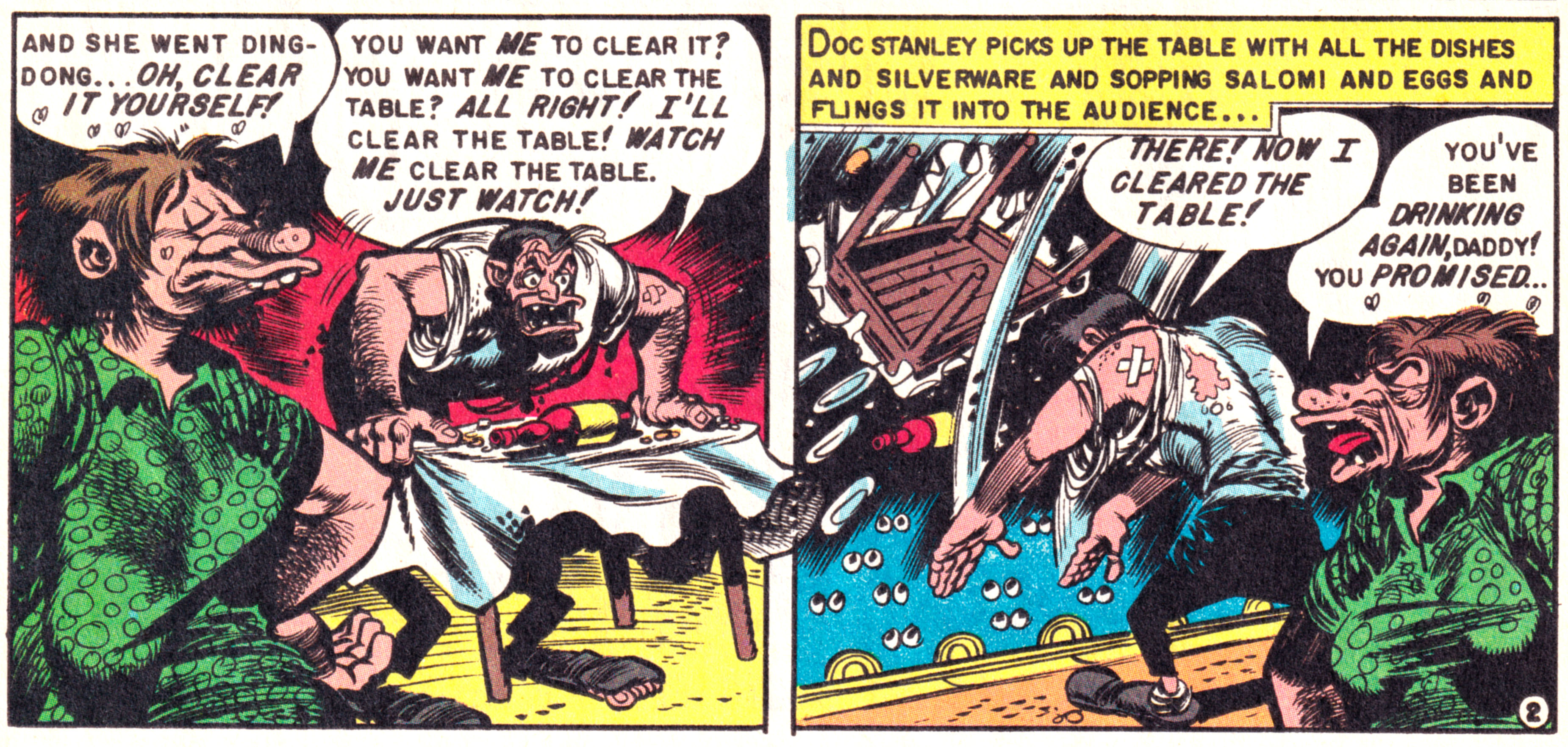
This story is mostly a parody of the stage production of "A Streetcar Named Desire", with a bit of "Death of a Salesman" and probably some other sources I'm missing. It's pretty amusing, a bit unusual in how it plays off the stage-play format, with jokes about the audience and stage directions (I especially liked the jokes about what happens in the intermissions between acts).

Davis really shines with the Stanley and Lola characters in this story. They're just a wonderfully comedic design for the absurd situations they're put in, wonderfully physical and expressive designs.
Overall a decent story, although of course Feldstein at this point wasn't quite as good at the parody as Kurtzman was over in MAD, but still did a good job in the best MAD rip-off mag.
art by Jack Davis, written by Al Feldstein
Panic #2 (1954)
If I had to pick a favourite EC artist, at least on the basis of their EC work alone, I would probably pick Jack Davis. He did some great work in all the genres, and some of his best work was in the humour books, MAD and PANIC. He's got a wonderfully lush inking style and can fill his panels with details without distracting from the main action.
This story is mostly a parody of the stage production of "A Streetcar Named Desire", with a bit of "Death of a Salesman" and probably some other sources I'm missing. It's pretty amusing, a bit unusual in how it plays off the stage-play format, with jokes about the audience and stage directions (I especially liked the jokes about what happens in the intermissions between acts).
Davis really shines with the Stanley and Lola characters in this story. They're just a wonderfully comedic design for the absurd situations they're put in, wonderfully physical and expressive designs.
Overall a decent story, although of course Feldstein at this point wasn't quite as good at the parody as Kurtzman was over in MAD, but still did a good job in the best MAD rip-off mag.
Saturday, March 05, 2005
Upcoming EC book - FOUL PLAY

Foul Play!
The Art and Artists of the Notorious 1950s E.C. Comics!
by Grant Geissman
Legendary publisher Bill Gaines is perhaps best remembered as the founder of MAD Magazine, but in the opinion of many dedicated comic book fans, his greatest achievement was E.C. Comics, a line of pre-code adventure, horror, and science fiction comics published in the 1950s that included the likes of Tales from the Crypt, The Vault of Horror, and Weird Science — bestsellers embraced by readers for their macabre wit and stunning illustration that are still prized fan-favorites even to this day. This lavishly illustrated tome celebrates the creators of E.C. Comics, as well as profiling such legendary artists as Al Feldstein, Harvey Kurtzman, Graham Ingels, Will Elder, Al Williamson, and Bernie Krigstein. Additionally, this book contains the never-before-published 1956 story, "Wanted for Murder!"
"Reflection of Death!,” from Tales from the Crypt #23 (April-May 1951). Illustrated by Al Feldstein. Written by Bill Gaines and Al Feldstein.
"Corpse on the Imjin!,” from Two-Fisted Tales #25 (January-February 1952). Written and illustrated by Harvey Kurtzman.
"Touch and Go!,” from Crime SuspenStories #17 (June-July 1953). Story by Ray Bradbury. Adapted and illustrated by Johnny Craig.
"Foul Play!,” from The Haunt of Fear #19 (May-June 1953). Illustrated by Jack Davis. Written by Bill Gaines and Al Feldstein.
"Horror We? How’s Bayou?,” from The Haunt of Fear #17 (January-February 1953). Illustrated by Graham Ingels. Written by Bill Gaines and Al Feldstein.
"Kamen’s Kalamity!,” from Tales from the Crypt #31 (August-September 1952). Illustrated by Jack Kamen. Written by Bill Gaines and Al Feldstein.
"The Precious Years,” from Weird Science #19 (May-June 1953). Illustrated by Wallace Wood. Written by Bill Gaines and Al Feldstein.
"Judgment Day!,” from Weird Fantasy #18 (March-April 1953). Illustrated by Joe Orlando. Written by Bill Gaines and Al Feldstein.
"The Night Before Christmas,” from Panic #1 (February-March 1954). Illustrated by Will Elder. Written by Charles Clement Moore.
"...For Us the Living,” from Weird Fantasy #20 (July-August 1953). Penciled by John Severin, inked by Will Elder. Written by Bill Gaines and Al Feldstein.
"Blind Alleys,” from Tales from the Crypt #46 (February-March 1955). Illustrated by George Evans. Written by Bill Gaines and Al Feldstein.
"50 Girls 50,” from Weird Science #20 (July-August 1953). Illustrated by Al Williamson and the Fleagle Gang. Written by Bill Gaines and Al Feldstein.
"The High Cost of Dying!,” from The Haunt of Fear #21 (September-October 1953). Illustrated by Reed Crandall. Written by Bill Gaines and Al Feldstein.
"The Flying Machine,” from Weird Science-Fantasy #23 (March 1954). Illustrated by Bernie Krigstein. Story by Ray Bradbury, adaptation by Al Feldstein.
The Best of the Rest! - Marie Severin! - Sheldon Moldoff! - Alex Toth! - Basil Wolverton! - Joe Kubert!
E.C. Christmas Party Art!
Looks like it'll be a good sampler of all the main artists and genres, and the extensive profiles of each artist should be interesting. Hopefully there'll be more (I've long wanted to see EC collections like THE BEST OF AL WILLIAMSON, THE BEST OF KURTZMAN etc, maybe a nice 200 pages for each main artist with further volumes for the more popular and prolific artists).
Wednesday, March 02, 2005
STEVE DITKO: SPACE WARS

Unfortunately about half the contents of this book duplicate stories that already appeared in the first two DITKO READER volumes, so there wasn't as much new to me as there could have been. It's a shame, with so much Ditko work that hasn't been seen in decades to have that much duplication in volumes released so close together and so similar in format. There was enough previously unreprinted artwork to make it worth picking up, and if you don't have the READER volumes yet it's great (I recommend you get the READER volumes first, as they have a wider variety of work, with a lot of fantasy, general sci-fi and western stories as well as the space opera types in here).
Among the interesting contents is the story "The Blue Men of Bantro", which features a comic book artist as a character. Doesn't appear Ditko modeled the character after himself, but he does have Captain Atom and the Mysterious traveler among the art on his wall.
One of the oddest stories is the latest, "Way Out, Man" from 1961. I'm not sure if the story makes much sense, but it involves Stanley, a total square, and his beatnik girlfriend Gigi. Then it gets weird, with Martian friends of Stanley helping him to adopt a beatnik lifestyle to better satisfy Gigi. Great artwork by Ditko in this one, very creative and at times surreal. Ditko doing straight humour is kind of rare, but a pleasure when he does. He uses a really odd exaggerated style with the design and movement of his characters that just cracks me up, and this particular story gives him a lot of material.
More fun in "The Enchanted Planet", where it's interesting to see how much of an influence of the EC stable shows in the early Ditko work (it can also be seen in many of the covers printed in here). It's a very fun and dynamic story full of classic sci-fi adventure elements (as well as, maybe, the source for the hair of a certain 1970s sci-fi movie icon. Or maybe not).
One complaint is the random order of the stories. The introduction has a list in the order they should be, but doesn't give a good reason for not printing them in that order. So the earliest story, the only 1954 story included, is in the middle of the book, and so is the latest. I could understand it if they had some sort of thematic grouping, but it seems truly random.
I also didn't understand the need for almost two dozen "title pages" in front of most of the stories, with the name of the book and enlarged reproductions of individual panels. Those were also random, usually but not always taken from the next story. A waste of pages that could have been filled with three or four other stories. It might have made sense if they had better source material so the enlarged panels actually showed more details (a few of the stories are obviously taken from printed comics, most of them look a bit better, maybe taken from original stats), but they really didn't.
Still a nice book, definitely worth a look for the Ditko fan.
Subscribe to:
Posts (Atom)