My kind of hero...

The Fin, by Bill Everett, from (oddly) COMEDY COMICS #9, 1942, as reprinted in THE GOLDEN AGE OF MARVEL v2, 1999.

The Fin, by Bill Everett, from (oddly) COMEDY COMICS #9, 1942, as reprinted in THE GOLDEN AGE OF MARVEL v2, 1999.
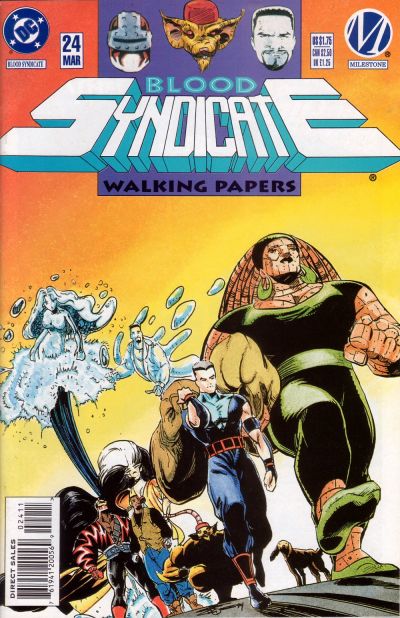
Blood Syndicate [1993 series]
35 issues [1993 - 1996]
1 - 35
BLOOD SYNDICATE was one of the four books that launched the Milestone line in 1993, the one team-book among their line, featuring members of various street gangs who band together (but still fight among themselves) after they get super-powers in the Big Bang which also gave Static and others powers. It had a rougher start than the other books, I think I remember hearing that the intended artist fell through at the last minute, so the first four issues had four different pencillers, which isn't the ideal way to start a book, even if they all were pretty good artists. Fortunately, one of those four, ChrisCross, stuck around and was the regular artist for most of the rest of the series, starting off a bit rough but quickly getting his footing.
The writing for most of the series is by Ivan Velez, co-writing the first storyline with Dwayne McDuffie and then solo for all but three fill-in issues. Velez was a new name to me, not having heard of his TALES OF THE CLOSET series until later, but he was really good, especially with the characterization, and also the use of a lot of the super-powers. A lot of well-developed characters who were fun to read about month-to-month, like Fade, Brickhouse, Third Rail and of course Dogg.
The first half of the run is the best, though it's hard to pick any particular issue, since it's one of those team books that flows from issue to issue, with subplots building each issue, cliffhanger endings and all that. The second half had some good stories as well, but a few pacing problems, partly because of a line-wide crossover that got in the way, and some fill-in issues that really missed the mark, and generally because the book seemed to be treading water. I think there was some talk of a few spin-off mini-series for some of the characters that never came out, so maybe there were developments planned for those that the series was waiting for, or stories it was setting up never came to pass. It ends pretty well, although a bit abruptly.
TARZAN: THE JOE KUBERT YEARS VOLUME 3 Hardcover
by JOE KUBERT
Writing, drawing, and editing a monthly Tarzan comic-book series in the 1970s, Joe Kubert was able to illustrate the adventures of his childhood hero and produce some of the most inspiring pages of his career. Dark Horse Comics is proud to present this final collection in a series of Joe Kubert's complete Tarzan comics. Tarzan: The Joe Kubert Years Volume Three features an incredible, four-part adaptation of Edgar Rice Burroughs' 1934 adventure novel, Tarzan and the Lion Man. Tarzan attempts to protect two beautiful actresses and a Hollywood production crew from the many dangers lurking in Africa's jungles... and from a deranged geneticist who calls himself "God." This volume also includes previously unpublished pages of Kubert's original Tarzan notes and thumbnails from the early 1970s, the Tarzan stories "Moon Beast," "The Magic Herb," and "Ice Jungle," and a Korak, Son of Tarzan, tale, "Leap into Death," which was inked by Russ Heath.
- Introduction by Joe Kubert!
- This volume features previously unpublished pages of Joe Kubert's original Tarzan notes and thumbnails from the early 1970s!
- A great reference for students of comics art and the human form in action!
- Represents a key period in Kubert's career, when he was juggling roles as Tarzan's editor, writer, and artist.
On sale June 28, Hardcover, 216pg, Full Colour, 6 1/4" x 10 1/4", $49.95
MAR060044 Dark Horse
THE ART OF S. CLAY WILSON Hardcover
by S. Clay Wilson; with an Introduction by R. Crumb
THE ART OF S. CLAY WILSON is the long-awaited career retrospective of the most extreme of the Zap cartoonists of the late 1960s. A self-described "graphic agoraphobe," Wilson draws manically dense scenes of lurid mayhem that rank among the seminal works of underground, counterculture American art. It's all here, from the classic chronicles of the Checkered Demon to salacious stories about the pirates, prostitutes, and poets that inhabit Wilson's divinely depraved world.
Hardcover, 9x12, 192pgs, Full Colour $35.00
MAR063635 Ten Speed Press
Bop Jokes!
art by John Severin, story by Harvey Kurtzman
Mad #9 (1954)
This is a pretty strange story from Kurtzman's MAD run. I think it might be one of those that made a lot more sense to people living in that era than it does a half-century later. The first page, with sixteen entries in the "Bop Dictionary", explaining, loosely speaking, a lot of the expressions used in the story, is pretty funny. Each of the next five pages presents a "Bop Joke", none of which make much sense, but I'm pretty sure they're not supposed to. It's the way they tells them, you see. Severin's art is mostly what sells it, with this weird world of hep cats, cubes and hollywood-eyes.
CAN’T GET NO
by Rick Veitch
Corporate exec Chad Roe had the “perfect” modern life. But the trophy wife, the prestigious job and the pills have always threatened to overwhelm him, and things go from bad to ugly when one night of debauchery hits the sobering light of September 11, 2001.
Comics iconoclast Rick Veitch (SWAMP THING, Brat Pack) writes and illustrates a graphic novel as singular in its execution as it is in the events it portrays. Half the height of a standard comic, told in landscape format with over 350 pages of story, Can’t Get No features Veitch inventing a poetry unique to the medium to tell the story of a man and nation torn by tragedy.
Reeling from the financial collapse of his business, Chad Roe descends into a night of depravity, only to wake up a “marked” man – literally – his body covered in a permanent tattoo. But Chad will be only one of the many whose lives are forever changed after that Tuesday morning of September 11, 2001. Instead of picking up the pieces, he takes to the road, heading straight into the shell-shocked heart of America on a desperate search for salvation.
7.25” 5.5” 352 pg, B&W, $19.99 US
MAR060378 DC/Vertigo
WALT & SKEEZIX VOLUME 2
by Frank King
Chris Ware has edited and designed this new 400 page hardcover volume of Walt & Skeezix, collecting the Gasoline Alley strips by the great American cartoonist Frank King from 1923-1924. King was the first cartoonist to have his characters age in real time and have modern storylines. In Book Two, Baby Skeezix is kidnapped, Walt’s courtship with Phyllis heats up and cools down, and Walt makes a bet with his friend Avery to see who can cross the North American continent first. There will be a new eighty-page introduction by journalist Jeet Heer exploring the strip’s Chicago background and the attraction that King and other cartoonists felt for the Grand Canyon.
Hardcover, 9x7, 400pgs, $29.95
MAR063183 Drawn & Quarterly
The Best of DC [1979 series]
35 issues [1980 - 1986]
4 - 6, 9 - 16, 18, 21, 23 - 30, 32 - 34, 37, 41, 43, 47 - 49, 55, 58, 60, 65, 68
Ah, the main DC digest title, lasting for 71 issues total. I was a big fan of the format in the early 1980s, although distribution on them was always a bit spotty on the newsstands, so I missed quite a few, and later on the supply of them dried up completely, so half of the ones I have I picked up later. Unfortunately somewhere in the last decade the price on the few you can find has gone up, and the print quality wasn't really meant to last 25 years, and a lot of the stuff has been reprinted in better formats, so it's hardly worth picking up the rest. Objectively these are pretty cruddy reprints, with the bad paper, bad printing and the pages often being chopped up to work in the smaller size (frequently they'd stat on slightly larger lettering, covering some of the art), but they make up for it in variety, with a great sampling of some of the best of DC's past, the first place I ever saw most of the 1950s and 1960s DC classics.
Most important from this title was that it's the first place I saw Sheldon Mayer's classic work, with the issues containing new and/or reprint Sugar & Spike stories, plus the various Funny Stuff issues with a few Mayer stories in each. That stuff is gold, and I'm glad they managed to do as many of them as they did. I recently got the last few of those I was missing, the only digests I was still actively searching for.
Also of note, the first places I saw favourites like Infantino's FLASH, Kubert's HAWKMAN, Kane's GREEN LANTERN, all sorts of stuff like that. I just loved the fact that you never knew what would come next in these, with an issue sampling the pre-hero adventure features in THE BRAVE AND THE BOLD followed by a sampling of Lex Luthor stories through the ages.
I previously posted about one especially odd issue, featuring the Super Jrs.
Noteworthy issues, well obviously any with Sheldon Mayer work, in particular #41 which is all Sugar&Spike work done for foreign markets after the original book was cancelled. #9 has the great Len Wein "Bat-Murderer" 5-part story from the mid-1970s, Jim Aparo art on the first few chapters, which I don't think has been reprinted elsewhere. #34 has the first four Metal Men stories from SHOWCASE, which are nicely strange.
THE TREASURY OF VICTORIAN MURDER VOLUME 8: MADELEINE SMITH Hardcover
by Rick Geary
A scandalous secret affair in 19th century Scotland between an upper class woman and a gentleman of lower standing ends in his murder by poison!
Hardcover, 6x9, 80pgs, B&W $15.95
MAR063325 NBM
Random Comics Theatre
Totems [2000]
Yeah, I pretty much agree with Swamp Thing's assessment there.
This is one of those "what were they thinking?" comics. It's a one-shot from Vertigo taking a lot of the characters that were around when the line launched (Swamp Thing, Shade, Black Orchid, Animal Man, John Constantine and Robotman from the Doom Patrol, most of them not being published at the time, plus a few cameos like Zatanna and the Phantom Stranger) and tossing them into a story about them facing the end of the world when the year 2000 begins.
Of course, the actual book takes about a third of its pages telling us the story of some unrelated and uninteresting character who crashes the rather unlikely party thrown by John Constantine which brings the characters together. I'd think if you had that many formerly headlining characters you'd want to have some fun with their interactions rather than devoting so much of the book to some new nobody. As it is the whole thing becomes a bit of "oh, look, it's that guy from that thing. And there's that other guy from the other thing. And look, they're talking to each other in this thing". It all just seems a lot less fun than you'd think having all these characters should be.
And while I stopped reading about most of those characters long before DC stopped publishing them, so I can't comment about how well their handled or if anything plays cleverly off their stories on where they'd be several years after their cancellation, nothing struck me as too profound. Shade says strange things, Robotman is a smart alec. Eh, overall just a wasted potential idea. I'm just glad I paid a lot less than cover price for it.
LITTLE LULU: ALL DRESSED UP TPB
JOHN STANLEY (Writer) and IRVING TRIPP (Artist)
Like all great "comics for kids," be it Charles Schulz's Peanuts, Bill Watterson's Calvin and Hobbes, or Carl Barks's Scrooge McDuck, these stories by John Stanley and Irving Tripp are legendary for their ability to delight both children and adults alike with their wit, insight, and outright hilarity. Witness two of the medium's masters at the very pinnacle of their talent and skill in these gut-busting stories featuring the smart and sassy, generous and gregarious, absolutely one-of-a-kind eight-year-old Lulu Moppet and her lovable cast of neighborhood troublemakers!
On sale June 14, Softcover, 200pg, b&w, 6" x 9", $9.95
MAR060034 Dark Horse
Legion of Super-Heroes [1984 series]
35 issues [1984 - 1989]
1 - 9, 11 - 14, 31, 37 - 39, 43 - 45, 49 - 63
This was the series that DC launched as one of their first direct market only books with the popular Paul Levitz and Keith Giffen team carrying over from the original series. Since it was direct only, I didn't buy it originally, but the LSH was one of the first books I checked out when I got back into comics, just as Keith Giffen was making his return with #50. I actually have pretty mixed feelings about that last year of the book, and was pretty close to dropping it if it wasn't going to be cancelled anyway by the end.
Along the way I did pick up some of the back issues when I could find them fairly cheap (I also have some more of them in the newsstand market reprints). Some of them are a lot of fun, and the art was generally nice, but I really do think that Levitz peaked on the book on the first half of his long run and very little of the second half compares well. Some of that has to do with the contortions the LSH history went through thanks to other changes in the DC Universe, but ultimately Levitz isn't blameless in that either. Still good enough to keep, and readable enough that I'd buy the stuff I'm missing someday.
My favourite bits of the run:
#1 - #5, the big series opening battle against the Legion of Super-Villains, a really good example of the best of Levitz's writing, both in plot structure, building tension and characterization. Also some really good artwork by Giffen, although it's kind of a shame his involvement decreased so rapidly during the story. One of the reasons I think DC's big direct market only launch for both TITANS and LSH at the time was so misguided is that the artistic side of the creative teams that launched the books took off so quickly.
#13 is a nice example of the single issue spotlight on a team member that Levitz would do every now and then, this one with Timber Wolf going on a mission to fulfil a wish for a dead team-mate.
#37 - #38 is one of those stories that tried to make sense of the changes in DC history and the effects on the Legion, but probably made the whole thing worse, but was pretty fun to read, even (maybe especially) without the Superman issues it crossed over with.
YOU CALL THIS ART?!!: A GREG IRONS RETROSPECTIVE Softcover
by Greg Irons
This retrospective book spans Greg Irons' artistic career, from his earliest dance posters, to his groundbreaking science fiction and horror comix, to his innovative and colorful tattoo art. Greg Irons was one of the elite among poster artists who worked for Bill Graham’s Fillmore Ballroom in San Francisco during the Age of Aquarius, designing posters for Chuck Berry, Jefferson Airplane, Big Brother, and Paul Butterfield. This book reprints his finest psychedelic posters in full-color, as well as complete comic stories from Slow Death Funnies, Legions of Charlies, Deviant Slice, Yellow Dog, Thrilling Murder, and many other underground comic books.
It also includes rarely seen album cover art for Jerry Garcia, Blue Cheer, Jefferson Starship and other counterculture musicians. Extras include never-before-seen pages from his private sketchbooks and journals, personal photographs, and works in obscure publications.
Softcover, 8x10, 240pgs, PC $24.95
MAR063213 Fantagraphics
The Patriots!
art by Jack Davis, story by Al Feldstein
Shock SuspenStories #2 (1952)
Interesting political story from EC, clearly a response to the whole "Red Scare" of the early 1950s America, as a crowd watches a parade of soldiers just returned from Korea. Some of the crowd react negatively to one man, who seems to have a sneer on his face as the soldiers go by, and then doesn't remove his hat as the American flag goes past. They decide he must be some sort of America hating communist foreigner, and start beating him, proud of their defense of their nation. Unfortunately, the man's wife soon returns and reveals he was an injured member of the army unit that just passed by, whose face was reconstructed so his smile looked like a sneer, and who was blinded in the war so couldn't see the flag.
A well intentioned story, I guess, but it does seem to side step the fact that the crowd would have been just as wrong killing the guy if he had been an America hating communist foreigner.
TEZUKA'S BUDDHA VOLUME 1 TP
by Osamu Tezuka
Japanese comics godfather Osamu Tezuka tells the story of Buddha's life like it's never been told before. The progenitor of manga as we know it, and the inspiration for countless artists, Osamu Tezuka continues to elicit the deepest awe with his sweeping grasp of the human condition. This life of Buddha is one that all ages and persuasions can enjoy.
Softcover, 5x7, 400pgs, B&W $14.95
MAR063136 Del Rey
Southern Command said the use of the restraint chair was recommended by the U.S. Bureau of Prisons as a safe way to counter hunger strikes. Craddock said in addition to using the chair, they have cut the number of strikers by separating the detainees who refuse food, to deter them from supporting each other in their strike efforts. Curiously, Craddock said that the soldiers give the detainees a choice of colors for feeding tubes: yellow, clear, and beige.
"They like the yellow," he said.
CARL BARKS' GREATEST DUCKTALES STORIES VOLUME 1 TP
A collection of Carl Barks adventures that were adapted to the popular DuckTales cartoon show. This volume features "Back to the Klondike," "Land Beneath the Ground," "Micro-Ducks from Outer Space," "Lemming With the Locket," "Lost Crown of Genghis Khan," and "Hound of the Whiskervilles."
Softcover, 5x7, 144pgs, Full Colour $10.95
MAR063223 Gemstone
DEOGRATIAS: A TALE OF RWANDA
by J. P. Stassen
The 2000 winner of the Goscinny Prize for outstanding graphic novel script, this is the harrowing tale of the Tutsi genocide in Rwanda, as seen through the eyes of a boy named Deogratias. He is an ordinary teenager, in love with a girl named Bénigne, but Deogratias is a Hutu and Bénigne is a Tutsi who dies in the genocide, and Deogratias himself plays a part in her death. As the story circles around but never depicts the terror and brutality of an entire country descending into violence, we watch Deogratias in his pursuit of Bénigne, and we see his grief and descent into madness following her death, as he comes to believe he is a dog.
Told with great artistry and intelligence, this book offers a window into a dark chapter of recent human history and exposes the West's role in the tragedy. Stassen's interweaving of the aftermath of the genocide and the events leading up to it heightens the impact of the horror, giving powerful expression to the unspeakable, indescribable experience of ordinary Hutus caught up in the violence. Difficult, beautiful, honest, and heartbreaking, this is a major work by a masterful artist.
Softcover, 6x9, 96pgs, Full Colour $16.95
MAR063221 First Second
Random Comics Theatre
New occasional feature here, I'm going to let my computer randomly pick a comic from my collection for me to re-read when I can't think of anything else to talk about or just want to add some variety to my reading list and the weblog. Well, semi-randomly, if it's something I've read recently, or that belong on another weblog or series of posts (so no Kirby, Ditko or EC) or something I'm too embarrassed to admit I own (so no, um, I guess I can't say) then I'll pick something else.
First spin of the wheel:
Wasteland #11 [1988]
Wasteland was an odd horror anthology title, with all the stories written by John Ostrander and/or Del Close, illustrated by several regular artists and the occasional guest artist. I'm always kind of surprised it lasted as long as it did, 18 issues, as it had a lot of uncommonly sick stuff and dark humour that you don't normally expect from a DC comic, especially way back then.
David Lloyd, a regular for the first year of the book, draws the first story this issue, "Embryo". His work in general is among my favourite in the series, especially since I don't think there's nearly enough David Lloyd work out there. He also tended to get the more depressing, completely lacking in humour stories in the book, which suits his style. This one has a son contemplating his relationship with his rather monstrous father on the father's deathbed, so that's quite a downer. Despite the nice art, I thought this story was just a little too bleak to really work.
"Revenge of the Swamp Creature" is the second story, part of a series of supposedly true (but take that with a grain of salt) stories from the life of Del Close, this one on the set of THE BLOB (and including a mention of his role in the SABLE TV show, which I didn't even know existed). Not a bad little story, although I got the idea that I was missing something at the end. Don Simpson, another regular, does the artwork for this one.
"Dissecting Mister Fleming" has art by Ty Templeton, I think his only story in the series. It's a pretty gory story that starts with a kid watching his father dissect a teacher alive on the gym floor, and goes down from there, so as you'd expect there's a lot of playing off the dichotomy of Templeton's open, cartoony art style and the subject matter. Definitely my favourite story in this issue, although you really need a strong stomach for it.
Another main series artist, William Messner-Loebs, wraps up the whole thing in a cover, not really one of his best, but okay.
FUN HOME Graphic Novel
by Alison Bechdel
This breakout book by Alison Bechdel takes its place alongside the unnerving, memorable, darkly funny family memoirs of Augusten Burroughs and Mary Karr. It's a father-daughter tale pitch-perfectly illustrated with Bechdel's sweetly gothic drawings and—like Marjane Satrapi's Persepolis—a story exhilaratingly suited to the graphic memoir form.
Meet Alison's father, a historic preservation expert and obsessive restorer of the family's Victorian house, a third-generation funeral home director, a high school English teacher, an icily distant parent, and a closeted homosexual who, as it turns out, is involved with male students and a family babysitter. Through narrative that is alternately heartbreaking and fiercely funny, we are drawn into a daughter's complex yearning for her father. And yet, apart from assigned stints dusting caskets at the family-owned "fun home," as Alison and her brothers call it, the relationship achieves its most intimate expression through the shared code of books. When Alison comes out as homosexual herself in late adolescence, the denouement is swift... graphic... and redemptive.
Hardcover, 6x9, 236pgs, B&W $19.95
MAR063248 Houghton Mifflin
The Incredible Hulk [1968 series]
36 issues [1976 - 1997]
196, 214, 235, 247, 249, 347, 368, 377, 393, 397, 400 - 401, 403, 405 - 425, 450 - 451
This HULK series took over the numbering from TALES TO ASTONISH, of course, and continued until 1999 when someone thought a new #1 was a good idea. I remember reading it a few times as a kid, but don't have those anymore. Most of the run I own is from Peter David's long run as writer. I tried it a few times early on, as the Hulk kept changing colours and personalities, and liked aspects of it, but it didn't really click for me until Gary Frank came aboard as the artist, with the Hulk green and intelligent, and it lost me again almost right away after Frank left (I used to have several other issues from before and after Frank's run, but they were pretty easy to get rid of).
Only picked up a few back issues over the years, a few because they had Steve Ditko artwork and a few other random ones which were okay, but not enough to make me search out more.
A few noteworthy issues among those I have:
#368 is a really good one-shot with Sam Kieth on guest-art and a good sample of Peter David's take on the character at the time.
#413 - #416 is a good sampler of the Gary Frank era, with an entertaining story of the Hulk in space, using the supporting cast of the time and various other Marvel Universe concepts.
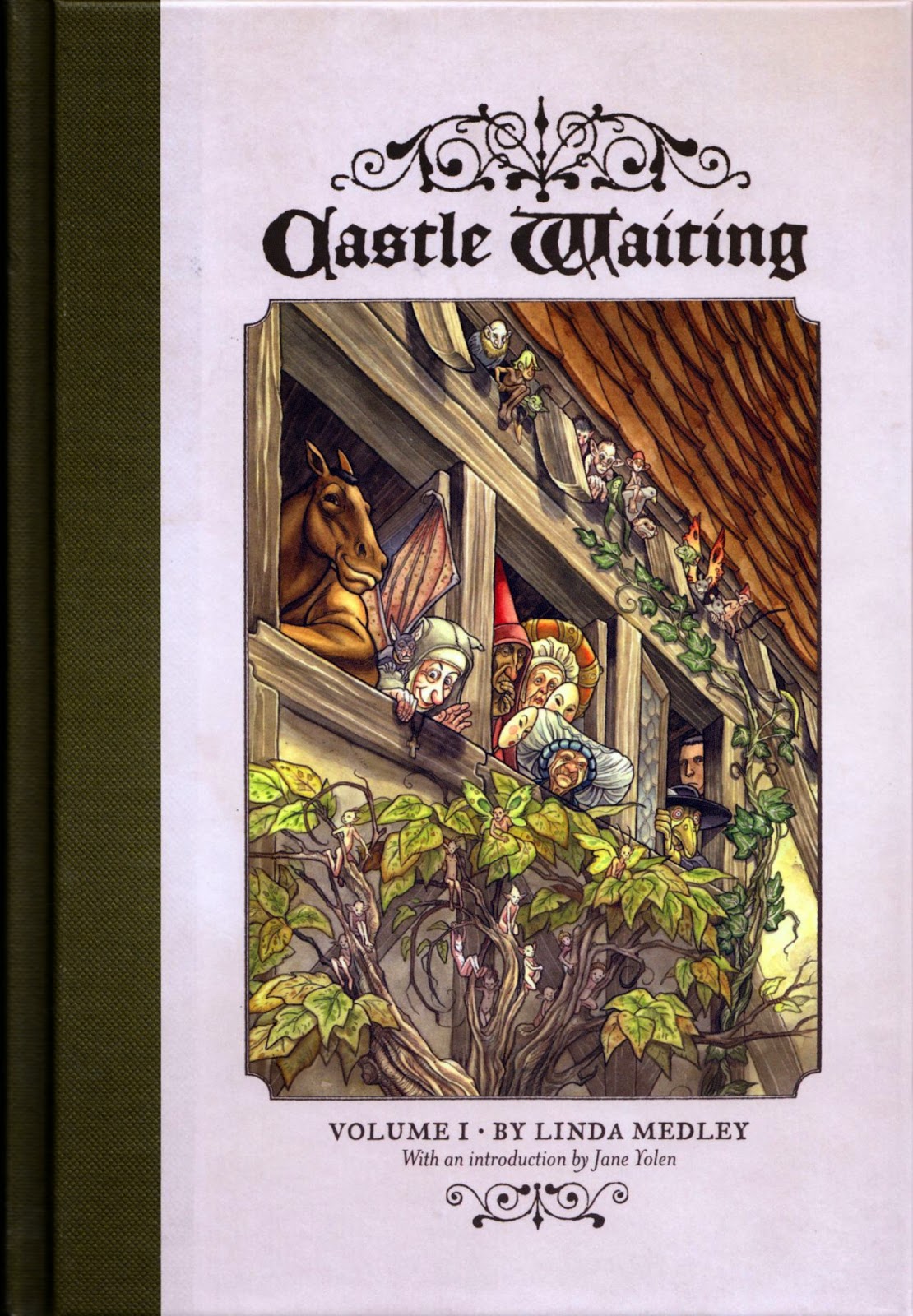
CASTLE WAITING Hardcover
by Linda Medley
This long-awaited hardcover edition collects the beginning chapters of Linda Medley's original graphic novel series, including all the stories from THE CURSE OF BRAMBLY HEDGE through SOLICITINE. The series garnered considerable critical acclaim, a number of industry awards, and inclusion in the YALSA Recommended Reading List.
CASTLE WAITING tells the story of an isolated, abandoned castle, and the eccentric inhabitants who bring it back to life. A fable for modern times, CASTLE WAITING is a fairy tale that's not about rescuing the princess, saving the kingdom, or fighting the ultimate war between Good and Evil--it's about being a hero in your own home.
Featuring an introduction by Jane Yolen.
Hardcover, 6.5x8, 448pgs, B&W $29.95
MAR063205 Fantagraphics
PATH OF THE ASSASSIN VOLUME 1 TPB
KAZUO KOIKE (Writer) and GOSEKI KOJIMA (Artist)
Path of the Assassin, called Hanzo no Mon in Japan, is the story of Hattori Hanzo, the fabled master ninja whose duty it was to protect Tokugawa Ieyasu. Ieyasu was the
shogun who would unite Japan into one great nation. But before he could do that, he had to grow up and learn how to love the ladies!
As the secret caretaker of such an influential future leader, not only does Hanzo use vast and varied ninja talents, but in living closely with Ieyasu, he forms a close friendship with the young shogun.
- Published in original Japanese format and unretouched which keeps the art intact.
- This is a fifteen-volume story starring the legendary ninja and Kill Bill reference Hattori Hanzo.
On sale June 28, Softcover, 320pg, b&w, 4" x 6", $9.95
MAR060017 Dark Horse
Trial By Arms
art by Wallace Wood, story by Wallace Wood & Jerry De Fuccio
Two-Fisted Tales #34[#17] (1953)
This story is a nice showcase for Wood's artwork, with a middle ages setting that allowed for some elaborate costumes and a lot of silent segments (including three full pages of combat with just brief captions or dialogue on the top tier). The story is simple enough, with one knight accused of killing another, and asking the Duke for trial by combat to prove his innocence. That sets the way for the three pages of Wood drawing the battle, and the finally ending that proves right doesn't always make right, and the illusion of honour is often more desirable than the fact of it.
PHOENIX VOLUME 7 TP
by Osamu Tezuka
At the end of the Heian Period (12th century), a hunter named Benta comes to Kyoto in search of his abducted assistant, Obuu. Obuu becomes the attendant of a powerful man of the time, who is searching for the phoenix. Meanwhile, Kyoto is driven into civil war, and their world is thrown into chaos and confusion.
Softcover, 6x9, 424pgs, B&W $15.99
MAR063510 Viz Media
I have no idea what this thing is...
...but somehow I now find myself in the market for one.
Score one for the power of advertising.
(on the other hand, I don't think I'd pay the cover price of over 10 new comics for it, which is what this would have cost in 1963. I guess in today's terms that would put the price at between $25 and $30)
Superboy [1994 series]
36 issues [1994 - 2000]
1 - 30, 50 - 51, 56, 69 - 70, 0
This version of Superboy was probably the best thing to come out of that whole "Death of Superman" thingee back then. The series lasted up to #100 a few years back, and I think the same character, with a different costume, is the Superboy still hanging around at DC right now, although who knows what's going on there in the next few months.
I didn't really expect to like the series that much when it launched, but I had liked some of Karl Kesel's writing before, and Tom Grummett's artwork looked nice. It wound up being a pretty good monthly read, nothing groundbreaking but a nice mix of short adventures, cliffhangers and a large supporting cast, including Dubbilex, the DNAlien from Kirby's 1970s run on JIMMY OLSEN. The use of the Hawaii setting was also good, at least different from the New York and New York stand-ins so common in comics.
I read it until Kesel and Grummett left with #30 (with a few fill-ins along the way), and didn't like the few after that I took a look at. The two returned a few years later with #50, but either something was off or I just wasn't in the mood for that type of thing at the time (I wasn't steadily reading any other monthly super-hero book at the time), because I didn't stick with it any of the times I sampled it. Those issues don't look too bad to me now, though, so maybe someday I'll pick up a few more of them when I'm in the mood for some light super-hero fun.
Noteworthy issues:
#4 has some nice artwork by Mike Parobeck doing a version of the book in the style of the Superman/Batman animated shows of the era.
#8 has a nice old Superboy vs. new Superboy, with some nice tributes to the original version, and one of the better things to come out of DC's "Zero Hour" crossover.
SHOWCASE PRESENTS SUPERMAN VOL. 2 TP
Written by Jerry Siegel, Jerry Coleman, Bill Finger and Otto Binder
Art by Curt Swan, Wayne Boring, Al Plastino and Kurt Schaffenberger
Cover by Swan & George Klein
The second Showcase spotlighting the Silver Age exploits of Superman features ACTION COMICS #258-275 and SUPERMAN #134-145! The Man of Steel faces off against a wide array of threats, from the impish Mr. Mxyzptlk to the deadly alien Brainiac to the utterly incomprehensible Bizarro.
576 pg, B&W, $16.99 US MAR060299
ABADAZAD BOOK 1: THE ROAD TO INCONCEIVABLE
by J.M. DeMatteis & Mike Ploog
This book marks Mike Ploog's first return to regular comics in years! Prepare for a wonderful all-ages story that features dozens of creatures and fantastical settings. If you like smart, literate, and lavishly drawn stories that can charm a nine year-old as well as adults, Abadazad will thrill you to no end!
Kate and her brother Matt are growing up in the big city, and life isn't always easy. They find refuge in the world of Abadazad - a series of books written over 100 years ago by classic author Franklin O. Barrie. Kate and Matt spend hours reading the Abadazad books, and know every character. One day, Kate takes Matt to the fun fair. He steps onto a carousel, goes around once, twice - and then disappears. Though Kate and her mother search for Matt for years, they never find him. Finally, Kate tells her mother they must give up looking - but on that very day, Kate meets an old lady, Martha, who also loves the Abadazad books, and seems to know more about them than anyone. Martha tells her that Abadazad is a real place, but Kate doesn't believe her - until a mysterious blue globe arrives at Kate's door, and Kate sees her brother trapped inside it. Now Kate knows what she has to do: she must go into the real Abadazad and find her lost brother, no matter what dangers it might hold.
Hardcover, 6x9, 144pgs, Full Colour $9.99 MAR063249 Hyperion Books
ABADAZAD BOOK 2: THE DREAM THIEF
The Plot: The Secret Story of The Protocols of the Elders of Zion
I just got around to reading Will Eisner's last book, THE PLOT, an attempt to bring the refutation of the Protocols of the Elders of Zion (a treatise used to incite anti-Jewish sentiment for the last century) into a popular form. It's an uneven but entertaining book, I thought. I've always had a mixed reaction to Eisner's non-Spirit "serious" comics, certainly admiring the storytelling and technical skills he brings, but often finding the melodramatic style and exaggerated characters a bit off-putting. Of those I read, only TO THE HEART OF THE STORM really worked for me throughout.
This book is quite different from his previous graphic novels, depicting Eisner's interpretation of historical events starting in mid-19th century France and moving to Russia and around the world. The first half of the book traces the origins of "Dialogues in Hell Between Machiavelli and Montesquieu", a French pamphlet used to criticize Napoleon III, and the attempts of certain Russian factions to block reform and modernization contrary to their own interests by using the Tsar's distrust of Jews, and how they merged in the creation of the "Protocols", purporting to reveal a vast Jewish conspiracy.
That all works very well, and is the best part of the book. Eisner drops a lot of information and dramatizes it well, not always realistically but effective and entertaining. It's a shame that towards the end of that section he just summarizes various other events in a quick text page, as it would have been interesting to see how he would have drawn that.
The next section of the book drags, unfortunately, as Eisner devotes about two dozen pages to the proof, discovered in the early 1920s, that the "Protocols" are indeed fake, mainly by comparing selections of them to the earlier "Dialogues in Hell" while a character reads along and makes some observations. It's hard going, especially since both of the source texts are pretty dull, and I can see why Eisner might have wanted to include them to give the book some scholarly heft, but it's not very good comics.
The final section picks up slightly, as he traces the wide dissemination and influence of the "Protocols" through the 20th century and beyond, starting with their use in the rise of Nazi Germany, despite clear evidence of their falseness and repeated attempts to debunk them once and for all. It's all short vignettes, and some work better than others, at times Eisner stages the scenes so that it feels more like the characters are talking to the reader than anyone around them in an attempt to get a lot of information in a short space.
Overall it's a book worth reading, but I think Eisner kind of tried to do too much, and might have better served the material by focusing on the first third more. The middle didn't really benefit from being done as comics, and the point of the last part probably could have been made more elegantly.
I'm not sure it all matters, though, as Eisner seems to avoid the point that the reason the fact that the "Protocols" are fake never takes, especially in the modern day, is that the actual text is irrelevant. Very little of what appears in the excerpts he selects has any bearing on modern anti-Semitism, and I doubt many of the widely disseminated copies are read at all. It's just a pretext for the hate, not the cause. I was going to tie this around to the current furor over those Danish editorial cartoons, but don't really have time to do the additional research. I think the connection is obvious enough, though. Anyway, while I can understand Eisner's desire to do a popular debunking of the "Protocols", and think the book is overall an artistic success, I'm not sure it'll actually convince anyone who needs convincing, if that was his desire.
There seems to be an abnormally long list of interesting stuff in the next set of solicitations (for books coming out in May and later), some of which I want to write about in more depth, and I usually glaze over on posts on other weblogs longer than three pages, so I'm going to do it a bit different this month, and try to post about one item from the solicitations every day or so (and hopefully that'll get me back in the habit of daily posting of other stuff on the weblog). For now, here are a bunch of pictures to serve as a preview of things to come (now updated so each picture is a link to my post on that book).