The Flying Machine
art by Bernard Krigstein, story by Ray Bradbury & Al Feldstein
Weird Science-Fantasy #23[#1] (1954)
Krigstein has probably been the EC artist to get the most attention in recent years, with two deluxe hardcovers published by Fantagraphics looking at his career and collecting some of his stories (B. Krigstein Vol 1 and B. Krigstein Comics). He was the last of the 14 major EC artists to join the company, doing a lot of work in the final two years of publishing in the late "New Trend" and then the "New Direction" books, working with other publishers in the few years around that as well in his brief career in comics.
He's an interesting artist, that's for sure. He brought a lot of elements, a strong cinematic influence (best seen in his classic "Master Race") and elements from his fine art training. I've always been especially fond of the odd inking style, how he would often contrast high-detail with looser more impressionistic work.
This particular story is one of the last of the Ray Bradbury adaptations published by EC, and as usual for them it's a bit wordy, but has a stong basic story. In this one, a Chinese emperor in AD 400 witnesses a man who has invented a flying machine. His reaction to this is less than enthusiastic, as he's afraid of what dangers this technology could bring in the wrong hands, and he deals with it quickly and cruelly.
Note, this story will be the Krigstein sample for the upcoming FOUL PLAY book of EC artists and their work.
Wednesday, March 23, 2005
Tuesday, March 22, 2005
EC - The Curse of the Arnold Clan (Craig)
The Curse of the Arnold Clan
by Johnny Craig
Tales From the Crypt #22[#6] (1951)
Craig is probably the EC regular whose work it took me the longest to warm up to. He always seemed to me to be a bit more of an "old-school" golden-age style artist. Eventually, mostly thanks to the crime work, I came to appreciate his moody work and storytelling.
This story features Robert Arnold, a man who goes through some family artifacts looking for an outfit for a costume party and discovers a book on his family history, where one brother killed another for an inheritance, earning a curse on him and his descendants so that the oldest Arnold gets buried alive every 50 years. Arnold doesn't believe this, of course, and so when a scavenger hunt that night calls for him to find an old musket he thinks nothing of going to the family vault and climbing into a coffin to hide when he’s in danger of getting caught. What a moron. No surprise he finds himself trapped and dies at midnight, fulfilling the curse.
Buried alive is of course one of the EC staples. Usually, as here, the result of a crazy level of stupidity. It has some clever twists, and I like the high-contrast work in the murder/curse sequence.
Sunday, March 20, 2005
PATTY CAKE & FRIENDS v2#13 by Scott Roberts
I recently picked up the 13th issue of PATTY CAKE & FRIENDS by Scott Roberts (having missed the last few), labelled on the cover as the 10th anniversary of the book. I'm amazed at how prolific Roberts has been in the last decade. Counting the previous series and specials this is, I think, the 42nd issue, and Roberts has always done a lot more comics than average in each issue (at least 30 pages in each issue prior to this series, about 48 or more in this series), plus extra work for tradepaperbacks and other books. I'm sure at this point he's done over 1500 pages of Patty Cake stories, plus lots of other comics work in the time (a long run on the Rugrats comic strip and now colouring Prince Valiant). Impressive even if the material wasn't good, but of course it is.
Unusually, a few guest artists this time around. That cover is a painting Roberts' mother did as a teenager, as this issue is dedicated to her with a very touching art and a note in the back (and a great backcover photo of a Patty Cake cake she made for him in 1967). Also an artist named Rich Watson draws a two page story, which is okay, but it always looks odd when another style is used for such a familiar character.
Two stories make up the bulk of the issue. "Future Shock" is an unusual one, jumping twelve years into the future and using a neighbourhood barbecue as an excuse to catch up on all the characters. It's an interesting look at how the fundamental characters don't change even as their situations do. I especially liked the use of cutaway scenes to absent characters and what they're doing as the main characters discuss them.
The second long story is a more typical Patty Cake story, "Chow Time", featuring her father taking her to a roadside diner. As you can imagine chaos ensues, coming from a variety of expected and unexpected sources. Patty Cake and her father have one of the most entertaining relationships in the book, and a story featuring the two of them out in the world is almost sure to be fun.
I'm glad that the book does well enough for Roberts to continue producing issues on a regular basis between his other work. For some reason it seems to fly under the radar of most comic stores (I've had to special order most of the issues I have, rarely seeing it on the stands), so I doubt that most people would enjoy it have seen it. It's well worth seeking out if you're a fan of the classic humour comics and animation work that influence Roberts' work.
Saturday, March 19, 2005
Zulli's "Last Morpheus"
One of the most fascinating comic book related things I've seen on the net recently is Michael Zulli's detailed documentation of the creation of his final Sandman painting, "The Last Morpheus". I've loved Zulli's work since I first stumbled across a copy of THE PUMA BLUES back in the 1980s, and he did some of my favourite issues of SANDMAN. I'm a total non-artist, but I'm finding the details of the process he goes through in getting this image right to be just captivating. Check it out.
http://www.michaelzulli.com/progress.htm
Friday, March 18, 2005
Link -- Dinosaur Comics
Just a quick note that Michael Ryan's Palaeoblog is starting to run Bissette's history of dinosaur comics. Should be fun.
A few more links, to some issues on my Jack Kirby weblog:
Devil Dinosaur #1 [1978]
Devil Dinosaur #8 [1978]
A few more links, to some issues on my Jack Kirby weblog:
Devil Dinosaur #1 [1978]
Devil Dinosaur #8 [1978]
Thursday, March 17, 2005
LA PERDIDA by Jessica Abel
Jessica Abel recently finished her longest comic book story to date, LA PERDIDA, published in five parts from 2001 to 2005. My first impression is that the ending is a bit of a let-down, although I reserve the right to revise that opinion when I get a chance to re-read the whole story (about 250 pages) straight through. Even if the ending isn't as strong, everything up to that has been excellent, and the art in the final issue is still strong, so I still recommend the series or the eventual collection.
The series is the story of Carla, a young woman from Chicago who spends a year living in Mexico. As we learn from the framing sequence that opens the first issue, a year after her return, things did not go well for her in the end. The main story opens shortly after her arrival and traces her gradually changing attitudes and relationships as she loses control of her life in the course of her year.
Abel's art has been strong on her earlier work in the ARTBABE series, but this series has definitely shown an increase in her skills. In particular I've noticed that the work has gotten a bit looser, more natural, and the use of shading has gotten more sophisticated. In this story it's also important that there be a strong sense of place to an exotic location for most of the readers, and she does a great job of that. There are several nicely illustrated scenes in the various issues, especially the covers of the first three issues (which you can see on the website).
You can sample a 16-page short story not included in the published issues, "Xochimilco" at Abel's Artbabe.com website.
Tuesday, March 15, 2005
EC - Come Back, Little Street Car (Davis)
Come Back, Little Street Car!
art by Jack Davis, written by Al Feldstein
Panic #2 (1954)
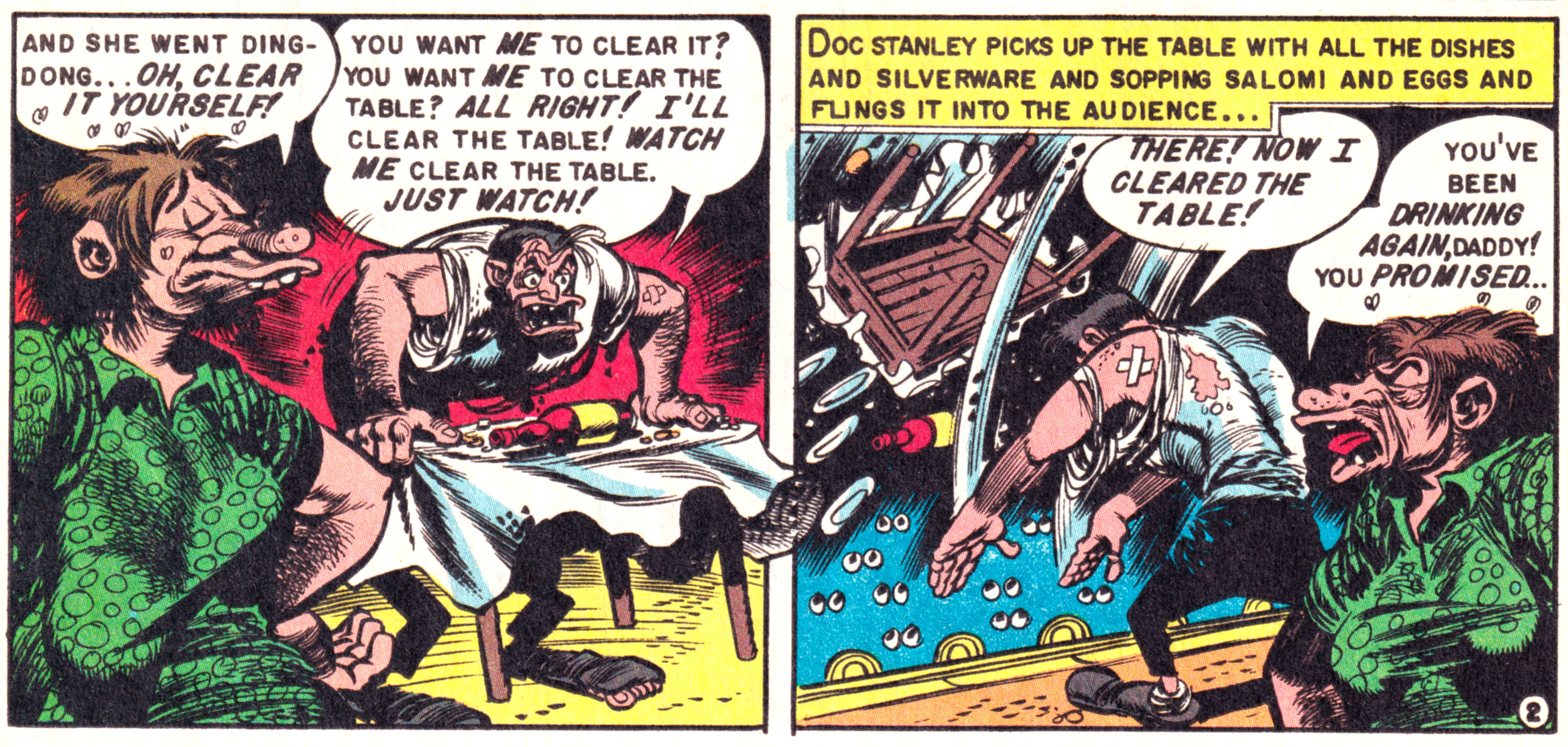
If I had to pick a favourite EC artist, at least on the basis of their EC work alone, I would probably pick Jack Davis. He did some great work in all the genres, and some of his best work was in the humour books, MAD and PANIC. He's got a wonderfully lush inking style and can fill his panels with details without distracting from the main action.
This story is mostly a parody of the stage production of "A Streetcar Named Desire", with a bit of "Death of a Salesman" and probably some other sources I'm missing. It's pretty amusing, a bit unusual in how it plays off the stage-play format, with jokes about the audience and stage directions (I especially liked the jokes about what happens in the intermissions between acts).
Davis really shines with the Stanley and Lola characters in this story. They're just a wonderfully comedic design for the absurd situations they're put in, wonderfully physical and expressive designs.
Overall a decent story, although of course Feldstein at this point wasn't quite as good at the parody as Kurtzman was over in MAD, but still did a good job in the best MAD rip-off mag.
Subscribe to:
Posts (Atom)