Links, tools and gadgets

Thursday, December 27, 2012

Keiji Nakazawa, R.I.P.

Keiji Nakazawa has passed away last week at age 73. He was the creator of the comics BAREFOOT GEN and I SAW IT, based on his first hand experiences as a child in Hiroshima during World War II and as a survivor of the atomic bomb dropped on that city on August 6, 1945, killing much of his family and having repercussions going on for years, often as a result of inexcusable negligence by both Japanese and American authorities. GEN is a fictionalized account, with the title character being a composite experiencing both things Nakazawa himself did and stories he heard of other survivors and victims. I SAW IT is a shorter work, more strictly autobiographical.

I don't really have much to add right now beyond what I've previously posted on this weblog. In fact, one minor reason for the lack of posting on this site over the last little while was my complete inability to adequately write about Nakazawa's work, with three different unfinished posts still sitting in my drafts folder. It's been over two decades since I first read his work, and it still has some of the most touching and heartbreaking scenes I've ever encountered in any work of art.

Here's a collection of covers from Nakazawa's work as translated into English. If you've never read his work, find some of these and read them.


In addition, artist Raina (SMILE, DRAMA) Telgemeier has a short comic about reading GEN at age 9, which everyone should read if they're curious about the power of Nakazawa's work and the importance of comics.

Friday, December 07, 2012

GodCorp revisited


Steve Bissette passes the news that Elaine Lee and Michael Kaluta got a "cease and desist" letter from Marvel/Disney over the Lee/Kaluta creation STARSTRUCK, which was briefly published by Marvel in the 1980s, following some stories printed by other publishers including Heavy Metal, and subsequently published by Dark Horse and most recently IDW. The matter seems to have been resolved to the creators' satisfaction, but really should never have gotten as far as it did.

In honour of the incident, some images from Steve Gerber and Jack Kirby's DESTROYER DUCK #1 (1982), that strike a resonant chord now more than ever. Gerber and Kirby were always among the most prescient of creators to work in corporate American comics, and prominent on the long list of creators to feel the sting of the corporate policies.

We're long overdue for a reprint of DESTROYER DUCK, aren't we? Hopefully soon. A new generation deserves to be introduced to Booster Cogburn...

Monday, October 22, 2012

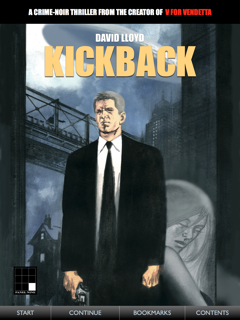
KICKBACK by David Lloyd

KICKBACK was the first major solo comic book work by David Lloyd, best known as the co-creator of V FOR VENDETTA. It was originally published in French by Editions Carabas and the first English language edition came out in 2006 from Dark Horse. Earlier this year it was released in a digital edition for the iPad by Panel Nine, their second release after Eddie Campbell's DAPPER JOHN, including the original 92 page story and various extras.

It's an entertaining little crime story about Joe Canelli, a somewhat corrupt but fundamentally good cop in a city where corruption is the rule, and the complicated web he finds himself in when those rules start to change around him, also bringing in some secrets from his past.

Of course the main attraction is Lloyd's artwork, which is always a welcome sight. It's perfectly suited to a crime story, with expressive faces and a good use of layouts to pace the story, especially in the frequent scenes with minimal dialogue. I'm not sure I was really sold on some of the more obvious uses of digital effects in both the art and the colouring (also done by Lloyd). A lot of uses of blur effects and photographic drop-in backgrounds. Those tended to call attention to to the effect more than they enhanced the story, especially with Lloyd's very organic linework. Some of them worked, and I'm sure that Lloyd will get better with the tools as time goes on, but at this point I'd have preferred the classic Lloyd look. Of course, I'm one of those still hoping we'll someday get a proper black&white edition of V FOR VENDETTA...

Among the extras are several pages of thumbnails, layouts and character designs, a cover gallery of the various previous print editions of the book in various languages and an interview with Lloyd about the history of the project, his process in creating it over several years and his disappointment over the marketing of the prior English publication. Some enjoyable stuff for those interested in the process of creating comics and the state of the market. Lloyd also provides audio commentary for many of the pages. I've listened to a few of them, and there seems to be some interesting stuff in there, but it didn't quite work for me. Come to think of it, I don't know I've ever listened to a commentary track for a movie on DVD all the way through except for THE USUAL SUSPECTS, and even for those I listened to in bits and pieces (usually just for especially good or especially perplexing scenes) I prefer it when there's more than one person doing the commentary, so it's a conversation rather than a monologue. The implementation seems pretty good though, with maybe a few tweaks needed, so it should be interesting to see in on some future books.

Well worth checking out if you missed the original print version. You can check out samples in Panel Nine's digital comics magazine INFINITY. As I've talked about before, the Panel Nine format is the best one I've tried, especially for longer form works, with a lot more thought placed into the layout and reading experience than others.

Sunday, August 12, 2012

Joe Kubert, R.I.P.


Sad to have to note the passing of Joe Kubert at age 85. Definitely one of the greats of comics on several levels. The art itself is paramount, of course, but he was almost as important as a teacher, with the long list of amazing artists who passed through his school.


A few images of Kubert on Kubert from DC Special #5 [1969], with the cover above.


The last page of a four page autobiographical story from that issue, with his advice to aspiring cartoonists a nice little precursor to the second career he later started as a teacher.

And also from that issue, a neat little look at a few characters he worked in the 1940s, even drawn same style, plus a preview of his then-new character Firehair (SHOWCASE #85-87, TOMAHAWK #132,#134 and #136).


You could write a book about Kubert's long career, but fortunately someone more qualified already did, Bill Schelly and JOE KUBERT - MAN OF ROCK [2008]. More recently, Schelly also edited THE ART OF JOE KUBERT [2011].

Check here for a list of over 1200 cover credits by Kubert (and that's not even all of them), click on any one of them for an illustration by a true legend.

Monday, July 30, 2012

Digital comics, INFINITY magazine and more


I've been thinking about doing a couple of posts about the various formats of digital comics and the various strengths and deficiencies (mostly deficiencies) of each. Might still, but then this was announced which will probably do it better...

Russell Willis sends news that he's launched INFINITY, a new free bimonthly magazine from Panel Nine about digital comics, with a preview issue out now for the iPad, soon to be available as a PDF without some of the iPad specific features, and a formal launch in September. Panel Nine is the publisher of the digital editions of Eddie Campbell's DAPPER JOHN and David Lloyd's KICKBACK, so as you can see from the cover, part of the issue serves as a promo for those two books, with a sample chapter of DAPPER JOHN and excerpts from the interview with Lloyd that appears in KICKBACK. The whole magazine is a nice demonstration of the overall design sensibility of the Panel Nine books, so worth checking out for that. It's one of the few companies that brings a design philosophy beyond just images of printed comics, but still preserving the best aspects of the print reading experience. DAPPER JOHN is still the most enjoyable digital reading experience I've had (especially among longer works, where the table-of-contents, chapter structure and bookmarking really enhance the readability).

In addition to the Panel Nine promotional stuff, there's a detailed look at an older iPhone developed comic, MURDERDROME, which got into some controversy a few years back when Apple rejected it for some over-the-top violence. I didn't pay much attention at the time, since I didn't have the equipment to read it banned or not at the time, but the interview with artist P.J. Holden is interesting, as are his various thoughts about the technical aspects of digital comics and how they're being developed.
The preview issue also has a collection of recent news on other digital comics and some reviews. Perversely, the most interesting thing to me was the almost exact opposite of digital, a look at the original INFINITY, a small press fanzine Willis published in the mid-1980s, with contributions from many of the most interesting British creators of the era, including Eddie Campbell, Bryan Talbot, Alan Moore and David Lloyd. Hope we see some more highlights of that in future issues.

Anyway, worth checking out. Since I got an iPad a few months ago, I've been thinking a lot about the various formats for reading comics. Almost all of them are much more satisfying than reading on a computer screen, but most of them are still far from ideal, a lot more thinking has to be done on how the technology can be used to enhance the reading experience. I find myself mostly in sympathy with the views that Willis has, so I still think that DAPPER JOHN is the gold standard. Of the major platforms, Comixology provides a fairly decent experience, especially for shorter works (which I'd define as under 50 pages). Fortunately on a high resolution screen their "guided view" is mostly unnecessary, since it often seems to be pretty poorly thought out if the layout is more complicated than a simple grid. I guess some people are still trying to read comics on phone screens as small as 4 inches for some reason and need to deal with that guided view, as inadequate as it is. I'd probably rank Dark Horse's app next, fairly straightforward, but a little buggy. iVerse is quite a step down from that, I wouldn't buy anything there if i didn't have an option to go elsewhere, which fortunately hasn't come up yet. And it's especially irritating when you open the app you're usually greeted with those awful Tarot comics in the featured area (presumably since those are as close to a major book that's iVerse exclusive?). And Apple's own iBooks is just not designed for comics at all, it's a prose reader designed to incorporate occasional illustrations, and has too many unnecessary stylizations trying to make the screen look like a print book. Awful reading experience. The Kindle app was recently upgraded so that some of the comics available on Amazon for the Kindle Fire should work on the iPad, but there's nothing up there so far I'd want to buy. I looked at a few samples, and it looks like it might be acceptable, about on par with Dark Horse's app. Their "panel view" looks like it's slightly more thought out than Comixology's version. The Kindle format should allow for some of the chapter structure that I want for longer works, but I don't know if they actually use it.

There are also a few other comics done as standalone apps, which is actually the format I'm hoping takes off for longer works. Nothing really stands out among them, a few go way over into the "motion comics" side, with animation and audio so they don't really qualify as comics anymore. Some get way too cute with the navigation, making them almost impossible to read.

I've also been playing around with various ways to read public domain scanned comics. There are quite a few readers for those, each with its own quirks. I think I've settled on one called iComix for now.

Anyway, should be an interesting few years while all this shakes out.

Saturday, June 16, 2012

A dozen or so comic links

James Vance just posted that he has the final pages of Dan Burr's artwork for ON THE ROPES, the upcoming sequel to their classic KINGS IN DISGUISE. That original is some great stuff, I'll have to pull it out and re-read it before the new book comes out. Burr's art looks sharp on the cover and brief look at the interior work that Vance posted, and the story (catching up on Freddie's story five years later in 1937) sounds intriguing.

Jay Hosler has a neat science comic by a promising newcomer, his son Max.

The Kirby Effect is the new journal of the Jack Kirby Museum, where you'll be able to find things like this 1992 interview with Kirby, both audio recording and transcript.

If you don't already have a copy of Michael Zulli's FRACTURE OF THE UNIVERSAL BOY, Zulli is now selling copies directly. Very beautiful and very strange book.

Mark Evanier on a meeting of Ray Bradbury, Julius Schwartz and Al Feldstein in San Diego, Part 1, Part 2,  Part 3 and Part 4.

Evan Dorkin posts the plot to an unpublished Rocketeer story.

Larry Marder has a copy of his upcoming BEANWORLD book, and the three previous books are all available digitally.

It's good to see Stephen Bissette with some new projects in the works, already including a Tyrant colour print (my copy seen to the left with an older Bissette Tyrant original and a Sam Glanzman Kona sketch) and some new t-shirts, with the promise of more to come.

Jim Lawson is serializing his original PALEO comics on-line, start here.

Or, if you prefer, I've started reading webcomics through Comic Rocket, which has a few problems but is already much more convenient than other ways of following webcomics. You can subscribe to PALEO over here.

Karl Kesel and Tom Grummett's SECTION ZERO is also back as a webcomic, with most of the existing pages already up, with a few new pages mixed in, and more new pages promised after the reprints are done.  Here on Comic Rocket or start here.

Nick Caputo has some interesting research on some rare Marvel comics, including BIG BOY and a NAACP voter registration giveaway.

Todd Klein has a detailed and well illustrated (photos and floor plans!) look at the DC production department of the late 1970s, Part 1 and Part 2.

Check out the Curt Swan artwork on Swanderful.


Friday, June 08, 2012

Robert L. Washington III, R.I.P.


Just wanted to briefly acknowledge the passing earlier this week of comic book writer Robert L. Washington III at the age of 47. Above and below the two sides of his trading card from the 1993 Milestone comics set.


I only had a few brief on-line interactions with Washington, back around 1993 when I first went on-line. I remember he had a high-energy enthusiasm in his on-line personality which perfectly matched what you'd see in his writing.

He's probably best known for his work on Milestone's STATIC series, co-writing the first few issues with Dwayne McDuffie and then solo for most of the next year.  The book was among my favourite monthly reads for most of that run, with a good balance of super-heroics and home and school problems for Virgil Hawkins to deal with, all told with clever dialogue and some imaginative uses of the Static's electrical powers. A very solid run of comics, which still holds up today.  Washington also wrote the first few issues of Milestone's SHADOW CABINET, which had some intriguing stuff.

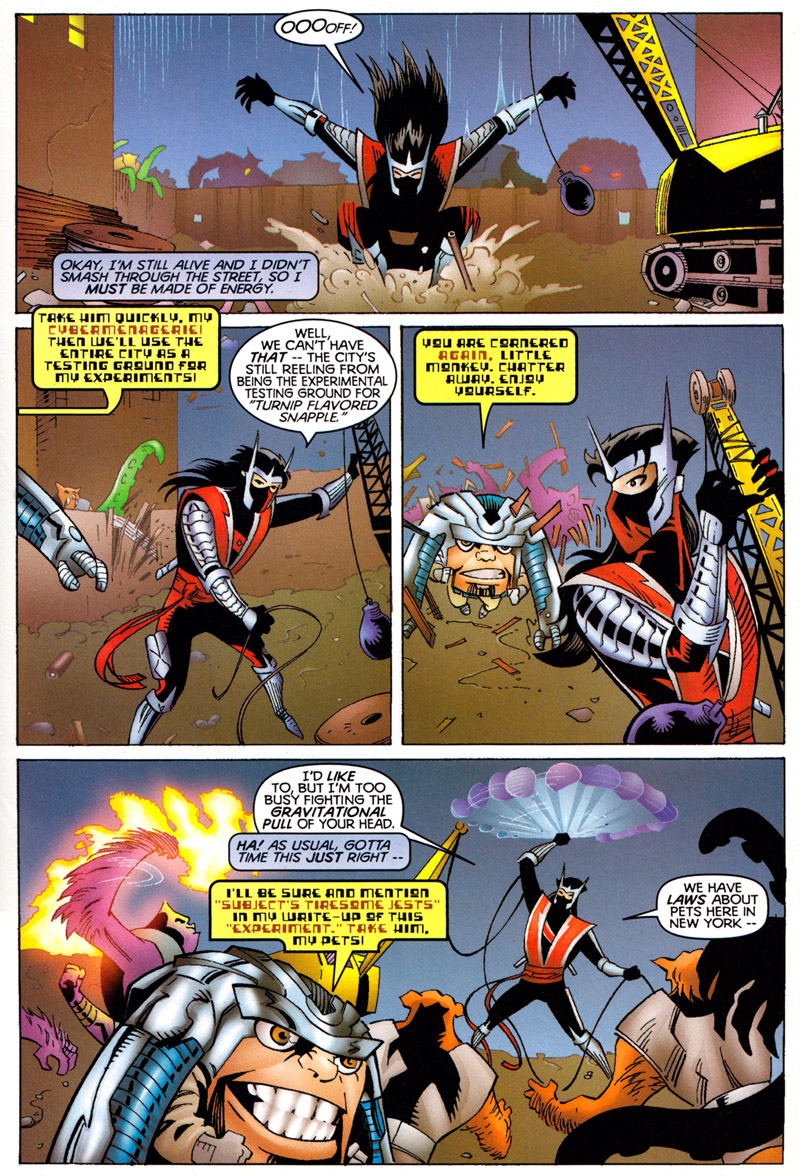
(art from STATIC #3, story Washington & McDuffie and art by John Paul Leon and Steve Mitchell)

The next, and unfortunately I believe last major comic book project that Washington wrote was Acclaim's NINJAK series in 1997.  Kurt Busiek was the initial writer on the series which completely re-imagined the title character into a teenaged boy who gains the ability to transform into his favourite video game character, and the complications that ensue from that, including the appearance of the villains from the game. I really enjoyed the series from the launch, much more than I expected to, and was very happy to hear soon after the launch that Washington was going to be writing the book. It seemed to be a perfect fit of creator and concept, and indeed the book only got better with the addition of Washington (officially his issues were co-written with Busiek, but according to a comment on Busiek's Facebook page most of the writing after their first few issues was essentially Washington solo). Unfortunately the series only lasted a year, but it was grand fun, with the same balance of teenage life and super-heroics that you had in STATIC. Just re-read the whole run, and it's still a breath of fresh air.

(art from NINJAK #9 by Washington & Busiek, art by Neil Vokes, Michael Oeming and Rich Rankin)

So while it wasn't a huge body of work, what there was from Washington was remarkable, a sense of fun and imagination applied to super-hero action in an entertaining way. I wish we'd had more of his unique voice.

Washington was among many comic book creators who were helped by The Hero Initiative, if you're able consider a donation tagged with his name to help them pay for Washington's funeral and continue their work.