Links, tools and gadgets

Tuesday, November 28, 2023

Rats #1 [1992] (Random Comics Theatre)

Random Comics Theatre

Rats #1 [1992]

This is a one-shot comic by Scott Saavedra, best known for the IT'S SCIENCE WITH DR. RADIUM series, also published by Slave Labor.  He also, coincidentally I'm sure, had a run writing CHIP 'N' DALE RESCUE RANGERS for Disney shortly before this.

The main story in this issue features a coming together of the main characters, two regular rats named Fred and Chowder, another rat named Reba who thinks she's a dog, and her brother, a cat named George (not sure if she thinks he's a dog as well).  They get involved in the machinations of a rat named Baron Molehang, who has vaguely evil plans that they foil.

Following the main story there's a two page gag with Fred and Chowder.

This is an entertaining comic.  I always like Saavedra's artwork, and in this one he really leans into the influence of Milt Gross, which is something we probably don't see enough in modern humour comics. 

Tuesday, October 24, 2023

Robert Kanigher's WRITING FOR COMICS 80th Anniversary Edition

HOW TO MAKE MONEY WRITING FOR COMICS MAGAZINES
80th Anniversary Edition
by Robert Kanigher
Famous Comics, 2023
ISBN - 978-1945307362

Robert Kanigher (1915-2002) was one of the most prolific writers of American mainstream comics, well known as the creator of characters like Sgt. Rock, The Metal Men, The Haunted Tank, Enemy Ace, King Faraday, The Flash (Barry Allen) and more.

In 1943, a few years into the business and having written for Fox, MLJ, Fawcett and others, he wrote a series of books on writing for Cambridge House.  HOW TO MAKE MONEY WRITING FOR COMICS MAGAZINES was one of them [*] (his original title was apparently BREAKTHROUGH before the publisher changed it).  The "Comics Magazine" version was recently reprinted in a print-on-demand book from the Famous Comics division of SD Publishing (branching out from their vast and growing Ditko catalog), with a lot of enhancements to the original and additional features.

[*] The others were HTMMW FOR THE MOVIES, HTMMW FOR THE STAGE, HTMMW FOR RADIO, HTMMW FOR NEWSPAPERS AND MAGAZINES and HTMMW POPULAR BOOKS.  Some of them were compiled into a hardcover HOW TO MAKE MONEY WRITING


As you can see, the new book is significantly bigger than the original.  It's also more than twice as many pages.  The first half of the book, following some new introductory material from editor Robin Snyder, is the full contents of the 1943 book. 

In addition, a Captain Marvel script from Fawcett is included as in the original, but now accompanied by the actual comics story from the Beck Studios, so you can make a script-to-page comparison. 


The original also has a Steel Sterling story drawn by Irv Novick from MLJ, along with a panel-by-panel running commentary by Kanigher.  The original presents the story in black and white, the new version in full colour.

It's an endlessly fascinating book. Kanigher writes it in a comfortably conversational spontaneous style (apparently he wrote all six books in six weeks for $500), but imparts a lot of information on his process.  You have to keep in mind that he's specifically talking about writing adventure comics featuring pre-existing characters for kids of the 1940s, so a lot of the specific advice is aimed squarely at that (and can be a bit dated 80 years on), but there's also a lot of general information that still applies on how to see the panel and page as distinct units that you need to think of in different ways from radio or film scripts, and how communicate information to the artist or sell the story to the editor.

But that's only the first half of the book, less than 100 pages of the 226 pages, even with the extra comic story included.  The rest of the book is a great general overview of the first decade of Kanigher's career in comics, including three more complete stories (Samson, Blue Beetle and The Bouncer), samples from some of his DC work (Wonder Woman, Green Lantern, Flash), including some rarities like unpublished script samples from planned later day returns to those characters.  Those are accompanied by introductory text by Robin Snyder and two long 1990s essays by Kanigher, "The Flushing Of Flash" (a look at his history with the Flash) and "So Long, Scribbly" (an epic obituary for Sheldon Mayer, and maybe the highlight of the book for me if I hadn't already read it).

And to top it all off, the first part of "The Mystery Of The Human Thunderbolt", an as-complete-as-possible year-by-year bibliography of Kanigher's writing and editorial work. Covering just his first decade in comics from 1941 to 1950 takes 34 pages.  Of course that barely scratches the surface, with his most prolific period as the editor and main writer of DC's war comics line and much more still ahead (previewed by a Sgt. Rock script rarity in the end of the book).

Great looking book, and much cheaper and easier to get than the original. As noted, it's print-on-demand, so readily available from various retailers on-line and (I think you can still do this) in person.  You shouldn't have to pay much more than US$35 and minimal postage (you can currently get one in Canada for under US$30 with all shipping and taxes.  Some places mark-up print-on-demand books to a crazy degree). Use the International Standard Book Number 978-1945307362. Options include:

Chapters/Indigo
Barnes&Noble
Amazon.com (adjust to your localized Amazon outside the US)
Bookfinder
AbeBooks

Sunday, October 15, 2023

Keith Giffen, R.I.P.

Sorry to hear about the sudden passing of Keith Giffen at age 70. Loved a lot of his work over the years, and always found it interesting.  Here are just a few examples in random order, as befits Giffen's style:

HECKLER was a series he created with Mary and Tom Bierbaum, published for 6 issues from DC back in 1992.  A really fun book that mixed slapstick and heroics in various unpredictable ways. 
Giffen had a long association with the Justice League, writing and doing breakdowns, working with J.M. DeMatteis and Kevin Maguire most prominently, plus dozens of others, for a five year run from 1987 to 1992, often with multiple spin-offs going on, and with various encore returns. This was the post-Crisis League, often playing for laughs and elevating second- and third-string heroes and villains, but also doing some great bits with the big guns and exciting dramatic stories.  That page down there is from #13, one of the few that Giffen fully pencilled.
Lobo is a character Giffen co-created in 1983 with Roger Slifer on the OMEGA MEN series, developing the concepts created by Marv Wolfman and Joe Staton.  At first a very minor character, he was developed as a more comedic foil in books like Justice League and L.E.G.I.O.N., especially the latter co-written by Alan Grant, who went on to co-write several Lobo solo stories with Giffen and various artists, including Simon Bisley and Kevin O'Neill.  Below is from the LOBO - INFANTICIDE mini-series, which, in a relative rarity, Giffen did the art solo, pencils and inks.
THE LEGION OF SUPER-HEROES is arguably the series where Giffen made the most impact, returning to it often for three distinct long runs, and a few shorter bits later (I was never clear on what happened with the last short bit...). The page below is from my favourite Legion run, the 1989 "Five Years Later" series written with Mary and Tom Bierbaum, initially drawn by Giffen and with a few other artists later. Dense stories building on the previous decades of Legion history, rewarding multiple readings over the years.
TRENCHER was an odd little project Giffen did in 1993 (four issues with a few later guest appearances, anthology stories and one-shots), one of the first times he wrote a project solo (usually working with co-plotters and/or scripters before this), and also handled the art solo, and even had a possibly fictitious editor (Bill "Bud" Shakespeare), so maybe the purest Giffen we ever got.  It's... strange. Hyper-violent, profane, absurd and many other things that aren't always compliments, but in this case might be. Giffen took big swings, sometimes that results in loud fouls.
DOMINION, co-written by Ross Richie, only lasted two issues from Image in 2003, the second of which lost its colour, so a rare chance to see Giffen in black and white (the other major one being the 1986 one-issue wonder THE MARCH HARE, and a story in TABOO). Some interesting concepts that weren't fully explored about an alien virus creating random super-powers.  Apparently Richie later restarted the series with other creators after he launched his own company, Boom, based on the concepts he and Giffen had for the series.
THE LEGION OF SUBSTITUTE HEROES SPECIAL from 1985... well, what can I tell you that the title doesn't? Matter-Eater Lad eats matter, and Stargrave's nose is made of matter, you do the math (and M-E Lad is one who made it to the Legion proper, so imagine what the Subs are like).
VIDEO JACK was a six-issue series that Giffen did with Cary Bates for Archie Goodwin's Epic line in 1987-1988.  A frantic mix of science fiction, comedy and TV parody.  I need to revisit it, been about 30 years since I've looked at it, but it looks bizarre.
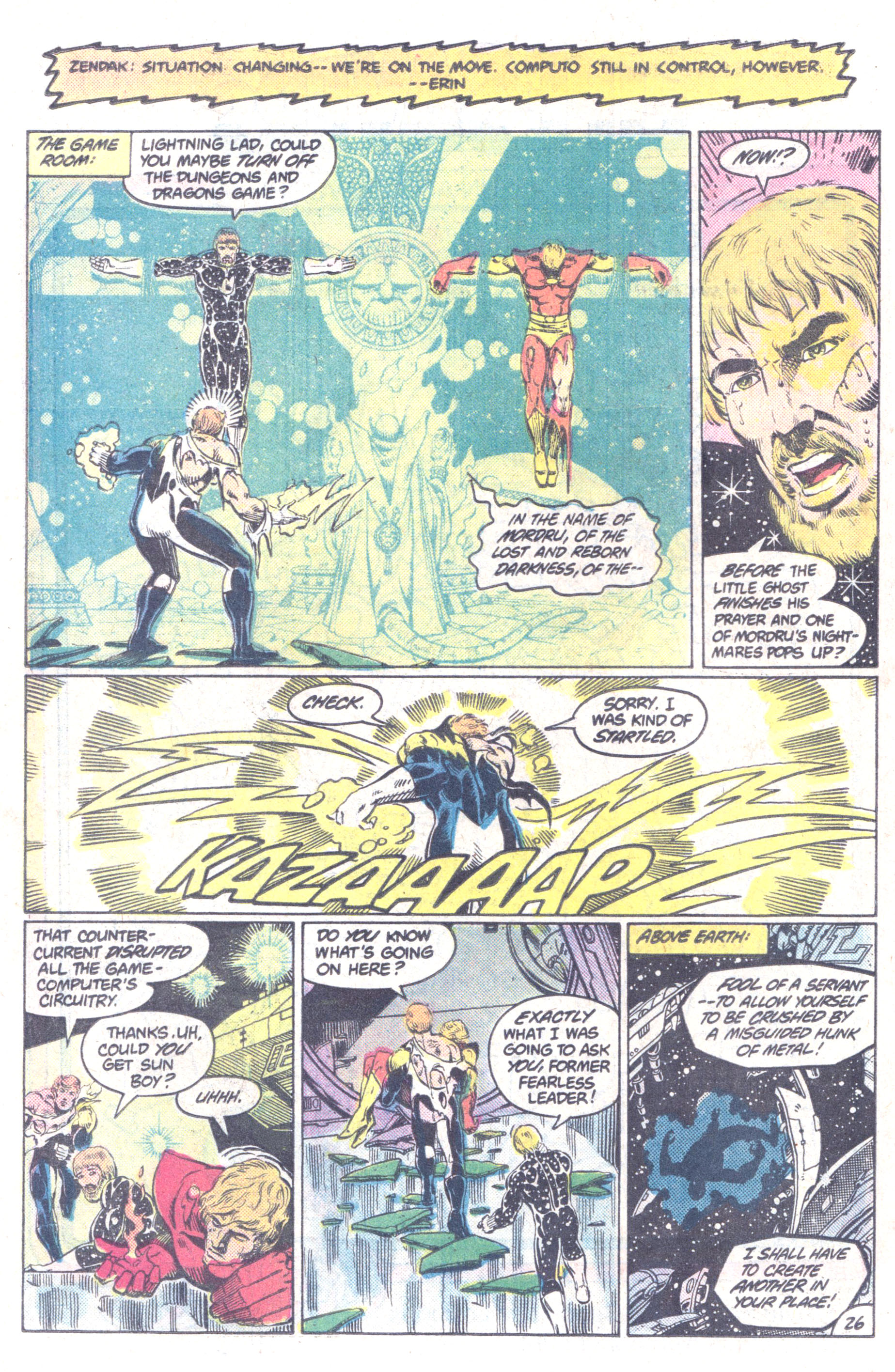
This is from early in Giffen's first Legion run, drawing and co-writing (with Paul Levitz) some of the best Legion stories ever, following a particularly fallow period for good Legion stories.  The Great Darkness Saga gets all the glory in this run, for obvious reasons, but I really love this story in ANNUAL #1 from 1982, which immediately precedes the first full chapter of that Saga, with Computo taking over Legion HQ.  Visually inventive throughout, well paced, faithful to the classic Legion designs while taking it all to another level.
The first place I really noticed Giffen was just before (and overlapping with the first few months of) his first Legion run, with a series of back-up stories in THE FLASH featuring Doctor Fate, written by Martin Pasko and Steve Gerber.  Playing around with page design in a way not too many mainstream artists were then, taking some big swings, connecting more often than not. He'd also return to Fate a few times. Also, tip of the hat to Larry Mahlstedt for his excellent inks of much of Giffen's work in this era.
I may have seen some of his work earlier, he's been around for a few years, mostly at Marvel, often with a style that, um, owed a lot to Jack Kirby, which isn't a bad thing to be at Marvel (something he'd go back to in ways both subtle and explicit throughout his career).  I've only read a few things from that era, like this SUPER-VILLAIN TEAM-UP issue and some Defenders and (at DC) JSA stories. I like what I've seen, at some point, now that more of it has been reprinted or is available digitally I should explore it.
More Legion, this from early in the 1984 Baxter run (if you know, you know).  Experimenting with a few different styles while he was at the top of the field and it would have been easier to coast on what was working
Okay, I'm not going to not include a page from The Great Darkness Saga in a look at Keith Giffen's work...
And of course, there's Ambush Bug.  Created by Giffen in 1982 as a kind of goofy throwaway villain for a Superman crossover with the Doom Patrol (well, y'know, "a" doom patrol...), somehow he kept coming back, getting steadily more absurd with every appearance, especially once co-writer Robert Loren Fleming and inker Bob Oksner joined in, leading to his own mini-series in 1985, eventually hitting absurd saturation point and then beating that in later minis and one-shots.  Became an amazing mix of playful storytelling, exploring and exploding the remotest corners of the DC Universe and comics in general.  Nothing quite like it before and since, right up to the 2008-2009 YEAR NONE series, which managed to lose a whole year and a full issue.  
And really, hardly begun here, especially since I concentrated on stuff he drew. So many other interesting things, like REIGN OF THE ZODIAC, INVASION, AQUAMAN, VEXT.  One could take forever to explore his career.

Oh, and let's look at some covers...


Sunday, October 08, 2023

Sugar&Spike - Volunteer Repairmen

The Chronicles of Sheldon Mayer's Sugar & Spike

Volunteer Repairmen

Sugar & Spike #18 [1958]
6 pages
Reprints: None
Dedication: Ann Charamak (age 14), Rye, NY [interestingly, Mayer settled in Rye for at least part of his retirement]

Spike gets put in the yard for playing with the window-box toy (TV), so Sugar invites him to her place (after the usual man-handling) to play with their window-box.  For some reason her mom objects to that, so they do some exploring and find a radio, which they interpret as a broken TV, since it has music but no picture, and proceed to try and fix it in the only way they know how, with Mr. Plumm's fix-it toys (tools).  Before they can act, they find Mrs. Plumm's laundry machine, and see the clothes jumping inside as another broken TV, with a picture but no music. Logic only dictates that you put the two together... And somehow for that they get put in a corner.

I did like that in the last panel the radio is still somewhat working, playing now-wobbly musical notes, but also making "glub glub" noises.  Because that's logical...

Well constructed story of the classic theme of seeing what a kid might do and figuring out what kind of baby-logic might have led them to that think their actions are perfectly justified.  

Characters: Sugar, Spike, Mrs. Wilson, Mrs. Plumm, Mr. Plumm
Damage: That radio might survive, but uncertain
Punishment: Initially just put in the yard, eventually into the corner
Sugar's treatment of Spike: The old trio, pushed over, stood on and dragged around by the feet.  But at least he complains about it...

"Why is it, the the cleverer we get, the angrier they get??"
"They're just jealous of our brains!"

Saturday, September 30, 2023

DC, wait a few decades and we'll get it right...

I've had occasion in the past to talk about a few lapses in DC's production department for their reprints, from the never-ending "...and meet the sun." Swamp Thing saga (see here and here and here.  Update, latest softcover and digital versions still missing caption, while the recoloured version is its own thing), to the missing word balloon in reprints of The Question (see here, missing in the $100 hardcover as well) to the missing words of God (and some questionable redrawing) in the British reprint of an old DCCP issue (see here. The story was finally reprinted a few times by DC proper since that post, with all the words as far as I know (edit to add, spoke too soon, wrong in at least one panel of SHOWCASE PRESENTS THE SPECTRE #1 [2012]).  Those are just a few of probably at least a dozen examples, some of which they corrected via recalls or at least in subsequent reprints, others which they seem content to keep repeating.

So I thought I'd take a look at the opposite, a few examples of errors in the original printings which they belated corrected in reprints decades later.

Back in 1973, Jack Kirby was wrapping up THE DEMON, on the 15th and penultimate issue he and inker/letterer Mike Royer used what was then a not unheard of but not terribly common effect of some solid colour lettering, with no black border (like the aforementioned DCCP issue did for the Word of God). The New York offices apparently couldn't handle it any better than the Brits could in 1983.  So readers were left to wait the inexplicable 36 years it took DC to finally reprint the issue in 2009 before they found out what the Klarion was exclaiming.


You do have to deal with DC's odd choice to eliminate the cover price from cover reprints.  Don't like that on issues where the price is so large, throws off the balance of the cover.

Jumping ahead to 1983, and LEGION OF SUPER-HEROES #302 artist Keith Giffen decided to save a few minutes and achieve an interesting visual effect by asking the production department to copy and enlarge a panel from the previous page a few times.  His note to that effect might have been a bit too subtle, so we readers got a backstage look at comic production, sort of like a boom mike coming into frame on a TV show.  Only took 28 years for the first reprint of the story in 2011 to come out, allowing DC's crack production team to finish the job.


And apparently there might be a Curse of Etrigan, because in 1987 Matt Wagner and Art Nichols revived the Jack Kirby creation, and in THE DEMON #1 there was a plot point about an old book that Glenda Mark had with a drawing of a demon named Belial who resembles Etrigan.  But we're shown a blank book.  Never seemed quite right, but at the same time a plot point is that Jason Blood can't see the resemblance, so maybe it was meant to be blank?  Well, this took only 27 years, but goof was seemingly confirmed in the reprint.


Interestingly, they also corrected the amusing error on the cover to #2, which prematurely announced it was the last issue of the mini-series.


There are a few more examples, if I remember exactly where they were I'll update, or feel free to add any you know of in the comments. No need to limit it to DC.

But this one is from DC.  In 1975 DC published an ambitious tabloid sized volume of Old Testament biblical tales from Sheldon Mayer, Nestor Redondo and Joe Kubert.  The big mistake is that they never published another volume, despite considerable work being done a second book of "The Story of Jesus".  But in addition to that, there's something off about the cover:


Apparently whoever coloured it was under the impression that Moses was going to auditioning for the Blue Man Group right after coming down the mountain.  I'm sure Joe Kubert flipped at seeing that, exclaiming "The Blue Man Group won't even exist for another decade, so they're definitely an anachronism in a Bible story!  And they would never hire someone with that hair". Took 37 years, but that fatal error was corrected in the 2012 hardcover reprint.

Here's one not from DC.

LARRY MARDER'S BEANWORLD - HOKA HOKA BURB'L BURB'L [2017] was going along swimmingly when, on page 146, something happened that's strange even for a book called Beanworld, when Proffy vanishes for a panel while discovering something about Bean life.


Creator Larry Marder discusses the reason for the mistake over here, and it was subsequently fixed in digital versions and in LARRY MARDER'S BEANWORLD OMNIBUS #2 [2019].

Monday, May 15, 2023

Good Miracle Monday

 A quick reminder to remember to set a place at the table for Superman tonight, the classic Miracle Monday tradition, as seen in this story from SUPERMAN #400 [1984] by Elliot S! Maggin and Klaus Janson.


Next year in Metropolis!

And if for some reason you've never read them, pick up Maggin's two Superman novels, LAST SON OF KRYPTON and MIRACLE MONDAY, now available in new editions self-published by Maggin.

(Superman created by Jerry Siegel and Joe Shuster)

Monday, February 13, 2023

Terribobble News!


From THE RETURN OF POGO by Walt Kelly